

Tiempo de lectura: 45 minutos
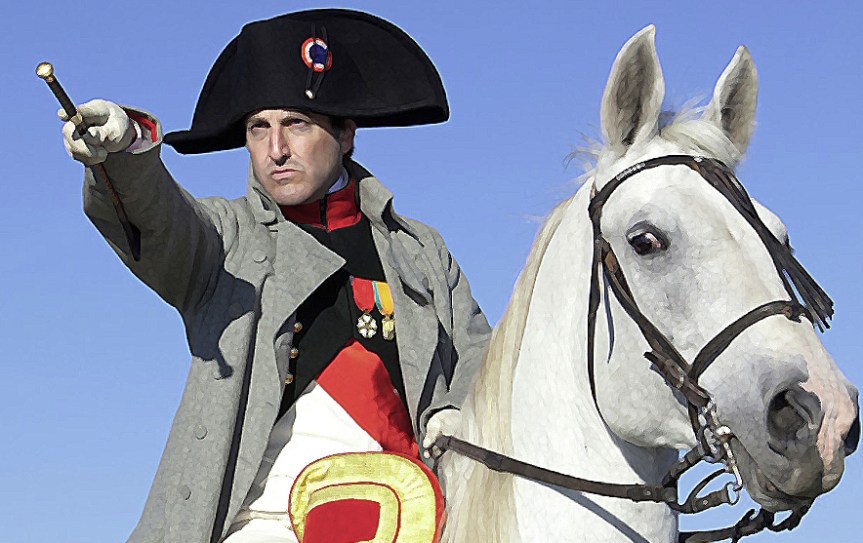
En vísperas de la conmemoración de la famosa batalla de Austerlitz, uno de los momentos militares cumbre en la historia del ejército francés, celebramos nuestra entrada número 500 en nuestro blog, y como en ocasiones anteriores hemos tenido la suerte de contar con un convidado de excepción para la ocasión: Mark Schneider, el alter ego americano de Napoleón, y que ha tenido la amabilidad de dedicarnos parte de su tiempo en una entrevista donde hablamos con él de sus actividades, el mundo de la recreación histórica y como no, de la vida de Napoleón I, que probablemente sea el papel por el que es conocido en muchos países.
On the eve of the commemoration of the famous battle of Austerlitz, one of the peak military moments in the history of the French army, we celebrate our 500th entry on our blog, and as on previous occasions we have been lucky enough to have an exceptional guest for the occasion: Mark Schneider, the American alter ego of Napoleon, and who has been kind enough to dedicate part of his time to us in an interview where we talk with him about his activities, the world of historical reenactment and of course, the life of Napoleon I, which is probably the role he is known in many countries.
ENTREVISTA / INTERVIEW
■¿Cómo un chico nativo de Long Island, que probablemente jugaba con soldados de juguete cuando era niño, se convierte en uno de los actores principales, si no el principal actor, que personifica a Napoleón hoy en día?
«De hecho, llevo bastante tiempo encarnando a Napoleón. De hecho, cuando era pequeño estaba fascinado con Napoleón. Desde temprana edad, mi madre solía decir que nunca conoció un momento en el que yo no estuviera fascinado con Napoleón. Mi madre era francesa, mi padre es americano, entonces esa es mi conexión francesa y desde muy joven recibí un soldadito de juguete de Napoleón y de ahí me enganché e interesé por Napoleón, pero comencé a encarnarlo teatralmente en 1999. Era parte de un grupo de recreación en Estados Unidos que recreaba la caballería francesa, que veo detrás de usted (Nota: mi imagen de fondo en la pantalla) y estábamos haciendo un evento de prensa en el que necesitaban a Napoleón y todos decían que siempre me veían como Napoleón, así que me puse el uniforme y comencé a encarnarlo. Y eso llevó a algunos documentales en los que participamos, algunos eventos históricos, eventos teatrales, y luego, en 2005, el Comité de Waterloo en Bélgica me preguntó para participar en la recreación de Waterloo. Debido al trabajo que hago en los Estados Unidos en el museo para el que trabajo, llamado Colonial Williamsburg, somos un museo de historia viviente en el que escogemos personas del pasado, les damos vida teatralmente y los presentamos en un escenario o cualquier entorno en el que nos encontremos. Y eso realmente ha tenido éxito en una nueva forma de enseñar historia. Entonces creo que apliqué eso al personaje de Napoleón cuando me invitaron a Bélgica para representarlo allí. Y eso se hizo popular entre otros recreadores, organizaciones históricas, museos, y me pidieron que viniera a muchos eventos. Así, pasó de Waterloo al 200º aniversario de Austerlitz, al 200º aniversario de Jena, a Erfurt, a todo tipo de eventos, de Francia a Alemania, a Bélgica, a la República Checa, a Italia, a España, a Rusia, a Austria… Es una oportunidad maravillosa para enseñar historia de una manera diferente.»
■ How a native Long Island boy who probably played with toy soldiers as a child becomes one of the main actors, if not the main actor, who impersonates Napoleon nowadays?
«So, I have been portraying Napoleon for quite a long time now. In fact, as a little boy I was fascinated with Napoleon. From the earlies ages my mother would often say she never knew a time where I was not fascinated with Napoleon. My mother was French, my father is American, so that’s my French connection and a very young age I received a toy soldier of Napoleon and from there I was hooked and interested in Napoleon, but I started portraying theatrically in 1999. I was part of a reenactment group in America that reenacted French cavalry, which I see behind you (Note: My background image in the screen) and we were doing a press event in which they needed Napoleon and everybody said I always looked as Napoleon, so I put together the uniform and started portraying him. And that led to some documentaries we participated in, some historical events, theatrically events, and then in 2005 I was asked by the Waterloo Committee in Belgiumto take part in the reenactment at Waterloo. Because of my work that I do in the United States at the museum that I work for, called Colonial Williamsburg, we’re a living history museum in which we take people from the past, bring them to life theatrically, and present them on a stage or whatever environment we’re put in. And that really has found success in a new way to teach history. So, I think I applied that to the character of Napoleon when I was invited to Belgium to portray him there. And that became popular among other reenactors, historical organizations, museums, and they requested of me to come to many events. So, it went from Waterloo to the 200th anniversary of Austerlitz, to the 200th anniversary of Jena, to Erfurt, all sorts of events, from France to Germany to Belgium, to Czech Republic, to Italy, to Spain, to Russia, to Austria… So quite a wonderful opportunity to teach history in a different way.»

■Ya veo. Y a través de estos años, estas representaciones y estas recreaciones, ¿uno puede entender por qué la gente, la gente de hoy en día, está fascinada por la figura de Napoleón?
«Sí, me gusta. Siempre me ha gustado la historia, por eso suelo decir que no la elegí yo, sino que la historia me eligió a mí. Porque incluso si no estuviera haciendo esto para ganarme la vida, incluso si no estuviera trabajando en museos y trabajando con la historia, todavía estaría aprendiendo sobre historia, leyendo libros sobre historia, descubriendo historia, visitando sitios. Entonces, nunca me interesó realmente el teatro, pero debido a mi interés por la historia y porque me dieron la oportunidad de actuar de esta manera, viviendo la historia, ahí es donde lo abracé. No me gustaría ir a Hollywood, no me gustaría ir a Broadway. No necesariamente amo el arte del teatro o la actuación, lo aprecio, pero encontré que es una manera maravillosa de contar la historia, de interpretar la historia. Entonces, desde el principio me di cuenta de que ésta era una oportunidad maravillosa para poder enseñar historia. Con el personaje de Napoleón, creo que desde el principio, desde mi primer evento en Europa en Waterloo, descubrí que la gente estaba disfrutando mi presentación de Napoleón, y si podía continuar trabajando en su autenticidad, trabajando en mis presentaciones, trabajando en todo, desde mi destreza a caballo y equitación, hasta mis discursos, mis gestos, la forma en que me comporto, entonces todo mejorará cada vez más. Y eso es lo que siempre me he esforzado por hacer, porque no soy sólo yo. No debería tratarse de Mark Schneider. Debería tratarse de las personas que retrato, en particular, en este caso, Napoleón Bonaparte. Ha vivido su vida; ha dejado su huella. Depende de nosotros saber lo que había hecho. Por lo tanto, es mi responsabilidad, mi obligación, como actor, como historiador, ante todo, contar la historia con la mayor precisión posible, para que otros puedan aprender del pasado. Así es. Y a través de estos años, y estos retratos y estas recreaciones, uno puede entender por qué la gente, la gente moderna, estaba fascinada por la figura de Napoleón. Sí. Bueno, creo que trasciende las edades. Creo que algunos de los problemas del mundo de Napoleón todavía existen en el mundo moderno. Y la forma en que los abordó, la forma en que los superó o fracasó, son lecciones del pasado. ¿No dijo el gran historiador Santayana que quien no aprende de la historia está condenado a repetirla? Así es. Napoleón era un estudiante de historia. Leyó sobre los grandes capitanes del pasado, de Alejandro Magno, de Aníbal, de Julio César, de Federico el Grande. Y los aplicó al campo de batalla moderno y a la situación moderna que encontró. Entonces, la fascinación del público moderno con Napoleón es que muy pocas veces, si es que alguna vez en la historia, ha aparecido alguien como Napoleón en el que era un meteoro. Abrazó la revolución que lo impulsó hacia adelante y pudo hacer muchas cosas positivas por el mundo. Sí, también negativas, pero las reformas del código jurídico francés, la creación de la Banque de France, la creación de la Legión de Honor, la creación de universidades y escuelas, la difusión de los ideales de la Revolución de la libertad, igualdad y fraternidad, todo lo cual influiría en Europa, América del Sur y, en última instancia, el mundo. Estas ideas no eran nuevas, pero supo transportarlas a través de su intervención en Europa. Por eso creo que el público moderno siente fascinación por él. No son sólo los uniformes. No son sólo las batallas. Son las personalidades en esta Era de Revolución. Ciertamente hubo, hay muchas transiciones en la historia, por supuesto. La caída del Imperio Romano y la entrada en la Edad Media, el Renacimiento, la creación del Estado nación. Y creo que las revoluciones en Estados Unidos y luego en Francia y luego en toda Europa y el mundo fueron uno de esos puntos de transición en los que, como resultado, el mundo nunca volvería a ser el mismo. Por eso creo que el público moderno siente tanta fascinación por él.»
■That’s right. And through these years, and these portraits, and these reenactments, one can understand why people, modern people, are fascinated by the figure of Napoleon?
«Yes, I like that. I’ve always loved history, so I often say that I did not choose history, but rather history chose me. Because even if I was not doing this for a living, even if I was not working in museums and working with history, I would still be learning about history, reading books about history, discovering history, visiting sites. So, I never really was interested in theater, but because of my interest in history, and because I was given an opportunity to perform in this way, living history, that’s where I embraced it. I wouldn’t want to go to Hollywood, I wouldn’t want to go to Broadway. I don’t necessarily love the art of theater or acting, I appreciate it, but I found it is a wonderful way in which to tell the story, to interpret history. So, it was early on that I realized that this was a wonderful opportunity to be able to teach history. With the Napoleon character, I think from the very beginning, from my first event in Europe at Waterloo, I discovered that people were enjoying my presentation of Napoleon, and if I could continue to work on its authenticity, working on my presentations, working on everything from my horsemanship and equitation, to my speeches, to my mannerisms, the way I carry myself, then it will just get better and better. And that’s what I’ve always strove to do, because it’s not just me. It should not be about Mark Schneider. It should be about the people that I portray, most notably, in this case, Napoleon Bonaparte. He’s lived his life; he’s left his mark. It’s up to us to learn about what he had done. So thus, it’s my responsibility, my obligation, as a performer, as a historian, first and foremost, to tell the story as accurately as possible, so others might learn from the past. That’s right. And through these years, and these portraits, and these reenactments, one can understand why people, modern people, were fascinated by the figure of Napoleon. Yes. Well, I think he transcends the ages. I think the problems of Napoleon’s world, some of them still exist in the modern world. And the way he dealt with them, the way he overcame them or failed from them, are lessons from the past. Did not the great historian Santayana say, those who do not learn from history are condemned to repeat it? That’s right. Napoleon was a student of history. He read about the great captains of the past, of Alexander the Great, of Hannibal, of Julius Caesar, of Frederick the Great. And he applied those to the modern battlefield and modern situation that he encountered. So modern audiences, their fascination with Napoleon is that very few times, if ever in history, has someone like Napoleon come along in which he was a meteor. He embraced the revolution that propelled him forward and was able to do many positive things for the world. Yes, negative as well, but the reforms of the French law code, the creation of the Banque de France, the creation of the Légion d’Honneur, the creation of universities and schools, the spreading of the ideals of the Revolution of liberty, equality, and brotherhood, all of which would influence Europe, South America, and ultimately the world. These ideas were not new, but he was able to transport them through his intervention in Europe. So that’s why I think modern audiences find a fascination with him. It’s not just the uniforms. It’s not just the battles. It is the personalities in this Age of Revolution. There were certainly, there are many transitions in history, of course. The fall of the Roman Empire and the entrance into the Dark Ages, the Renaissance, the creation of the nation state. And I think the revolutions in America and then in France and then across Europe and the world were one of those transition points in which the world would never be the same as a result. So that’s why I really think modern audiences find such a fascination with him.»
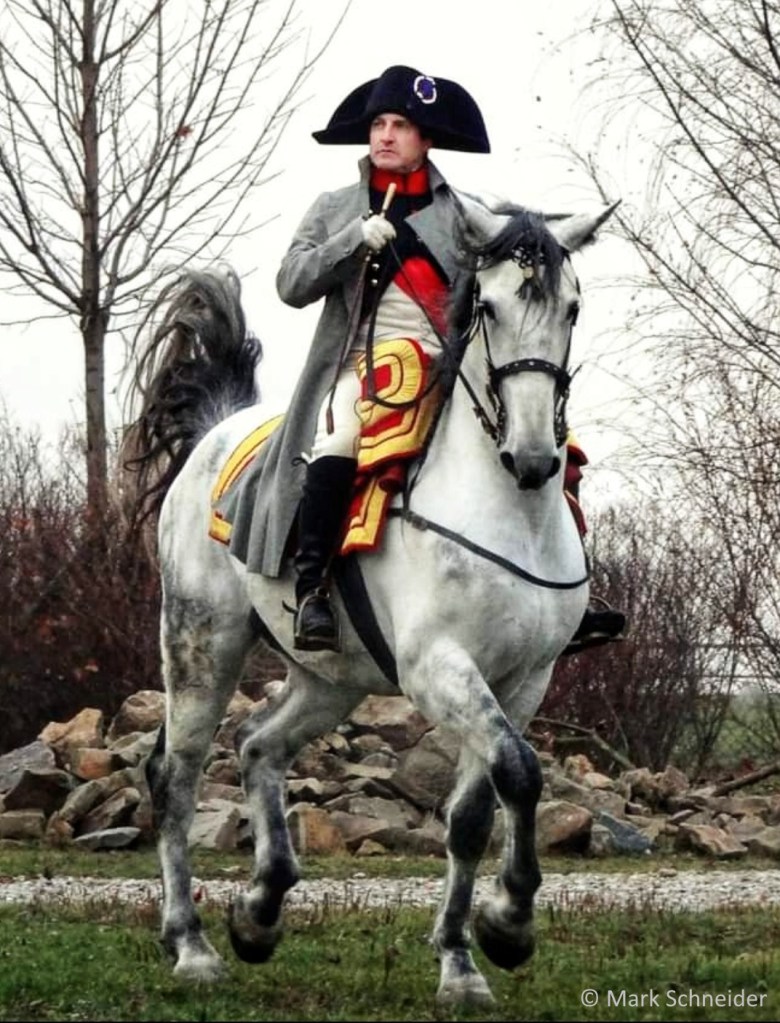
■ El emperador en su caballo blanco y su fusta de montar. Napoleón gustaba de los caballos de raza árabe y darles nombres como Alí, Visir, Fayoume, Emir, Nerón, Marengo, etc.
■ The emperor on his white horse and his riding crop. Napoleon liked Arabian horses and gave them names such as Ali, Vizier, Fayoume, Emir, Neron, Marengo, etc.
■ Como dijiste, has trabajado con el Colonial Williamsburg Living History Museum. Por lo que, en cierta manera, como un verdadero maestro, enseñas historia a la gente. Pero no piensas que en España, Europa quizá, sabemos que el estudio de las humanidades, del arte, está disminuyendo. Porque a los jóvenes no les interesa o quizás no tenemos los recursos adecuados. Como alguien dijo, ¿quizás tenemos que aprender a enseñar la historia como en los videojuegos?
«Tienes toda la razón. Sé que no es sólo en los Estados Unidos, pero es en todo el mundo donde las humanidades y la enseñanza de la historia Cada vez hay menos presencia en escuelas y universidades. E incluso la gente está cada vez menos interesada en ello. Eso es un problema. Porque lo que dije antes sobre la cita de Santayana, quien no aprende de la historia está condenado a repetirla. ¿No vemos que todos los días se repiten los mismos errores de la historia? Levantamos el periódico, miramos las noticias y vemos que ocurren los mismos problemas. No hay nada nuevo bajo el sol. Todo ha sucedido antes. Si aprendemos de la historia, seremos más capaces de afrontarla. Por eso lo encuentro tan importante con instituciones como la mía, Colonial Williamsburg, y con sólo un aula de historia en las escuelas, o con personas que eligen la historia como vocación, son muy importantes. Y es un desafío en el que la gente no está tan interesada. Entonces, ¿cómo hacemos para que se interesen?Sí, puedes coger un libro, y ese libro no será muy interesante, tal vez para todo el mundo. Pero si podemos darle vida a ese libro haciendo que alguien se sumerja en la historia de este personaje,
ya sea Julio César, ya sea alguien del Renacimiento, ya sea Napoleón Bonaparte, entonces puedes verlos teatralmente y divertirte, pero también aprender de ellos al mismo tiempo. Por eso me encanta esta forma de enseñar historia, de vivir la historia, porque recibo comentarios de personas que dicen, ya sabes, odiaba la historia, pero fue divertido aprender historia de la forma en que la presentas. Entonces, si estamos marcando una diferencia, incluso con una sola persona, creo que eso es éxito. Y debemos seguir esforzándonos, cambiando, adaptándonos, modificando, para no cambiar la historia. Definitivamente no. Ya ha ocurrido. Hay que presentar la historia, lo bueno y lo malo de la historia, entonces la gente aprenderá de ello. Pero podemos encontrar diferentes maneras de presentar la historia, y constantemente intentamos generar nuevas ideas, en lugar del libro de texto en blanco y negro, que dice: Napoleón nació en 1769, se convirtió en emperador en 1804, perdió en Waterloo en 1815 y murió en 1821. Bien, esas son fechas, esos son hechos, esos son verdad, ¿Pero son terriblemente interesantes para todos? No. La historia de su nacimiento es interesante, la historia de cómo se convirtió en emperador es interesante. ¿Y sabes cuáles son? Todas son historias humanas. Entonces, ames la historia o no, sigues siendo humano. Has experimentado la felicidad, tristeza, triunfo, humillación, todos hemos experimentado esas cosas. Entonces, si podemos conectarnos con esas personas del pasado, eso las hace más humanas. Es más que una pintura en la pared de un museo, es más que el libro que se escribió sobre ellos. Esos soldados, esos jinetes que están detrás de ti, quiero saber la historia de todos y cada uno de ellos. ¿Con qué estaban lidiando en ese momento? ¿Estaban todos asustados? ¿Estaban felices? ¿Cuáles eran sus relaciones? Todos son humanos, por lo que todos tienen una historia. Y eso es lo que para mí es la historia.
■ As you said, you have worked with the Colonial Williamsburg Living History Museum. By that, you, in the meantime, as a real teacher, teaching to the people history. But you don’t think in Spain, Europe perhaps, we know that the study of humanities, art, is decreasing. Because young people are not interested or perhaps, we don’t have the proper resources. Someone said that perhaps we have to learn to teach the story as video games?
«You are absolutely correct. I know it’s not just in the United States, but it’s across the globe that humanities and the teaching of history is becoming less and less in schools and universities. And even people are becoming less interested in it. That is a problem. Because what I said earlier about the quote from Santayana, those who do not learn from history are condemned to repeat it. Do we not see the same mistakes from history being repeated every single day? We pick up the newspaper, we look at the news and we’re seeing the same problems occur. There’s nothing new under the sun. Everything has happened before. If we learn from history, then we’re better able to deal with it. That is why I find it so important with institutions such as mine, Colonial Williamsburg,and with just a history classroom in schools, or people choosing history as their vocation, are so important. And it is a challenge in which people are not as interested. So how do we make them interested? Yes, you can pick up a book, and that book is not going to be terribly interesting, perhaps to everybody. But if we can bring that book to life by having somebody immerse themselves in the history of this character, whether it’s Julius Caesar, whether it’s anyone from the Renaissance, whether it’s Napoleon Bonaparte, then you can see them theatrically and be entertained, but also learn from them at the same time. That is why I love this way of teaching history, of living history, because I do receive feedback from people in which they say, you know, I hated history, but it was fun to learn history the way you are presenting it. So, if we are making a difference, even with one person, I think that is success. And we must continue to strive, to change, to adapt, to modify, not to change the history. Definitely not. It has already occurred. We must present the history, the good and the bad of the history, so, people will learn from it. But we can find different ways in which to present history, and we are constantly trying to come up with new ideas, rather than the black and white textbook, which says, Napoleon was born in 1769, he became emperor in 1804, he lost at Waterloo in 1815 and died in 1821. Okay, those are dates, those are facts, those are true,but are they terribly interesting to everybody? No. The story of his birth is interesting, the story of him becoming emperor is interesting. And you know what they are? They are all human stories. So, whether you love history or not, you are still human. You have experienced happiness, sadness, triumph, humiliation, all of us have experienced those things.So, if we can connect with those people of the past, it makes them more human. It is more than a painting on the wall in a museum, it is more than the book that was written about them. Those soldiers, those horsemen that are behind you, I want to know the story of each and every one of them. What were they dealing with at that moment? Were they all frightened? Were they happy? What were their relationships? They are all human, so they all have a story. And that is what to me history is.»
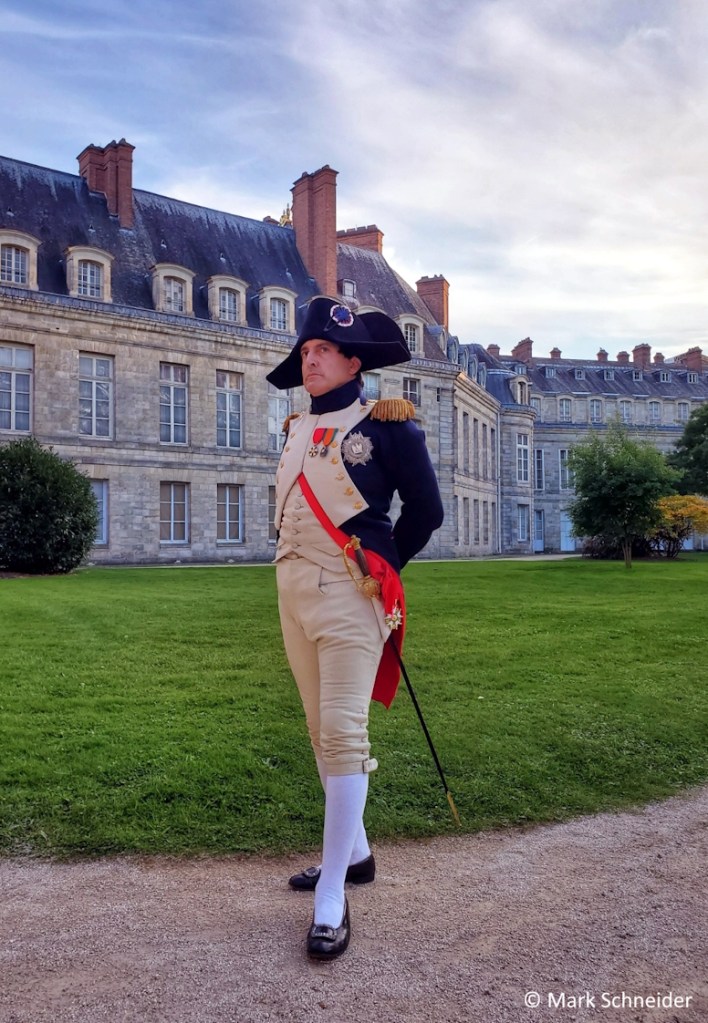
■ Mark Schneider llevando las condecoraciones de la Legión de Honor (Napoleón solía llevar del tipo 2 o 3), la orden de la corona de Hierro de Italia, la Placa de Gran Águila cosida, también con la banda roja de Gran Águila.
■ Mark Schneider wearing the decorations of the Legion of Honor (Napoleon usually wore type 2 or 3), the order of the Iron Crown, the Badge of Great Eagle sewn, also with the red band of Great Eagle.
■Yo pensaba lo mismo. desde luego. Absolutamente. ¿Alguna vez te has inspirado en las actuaciones de otros actores que han interpretado a Napoleón en la televisión o en el cine? ¿O has preferido no dejarte influenciar por otras actuaciones, ni siquiera por el público en general?
«Oh, absolutamente. Ciertamente he sido influenciado. Ya sabes, puedo ser influenciado, puedo ser motivado por actores y actuaciones en televisión o en el teatro. Pero en última instancia, depende de mí crear lo que creo que es ese personaje. Entonces, Napoleón es un ejemplo perfecto. Cuando era niño vi todas las películas sobre Napoleón. Desde Rod Steiger interpretando a Napoleón en la película «Waterloo» de 1970, me encantó. Desde Herbert Lohm, un actor checo que Interpretó a Napoleón en «Guerra y paz» de 1956. Me gustó mucho. Armand Assante, que interpretó a Napoleón en “Napoleón y Josefina: Una historia de amor”, de 1987, fue una gran inspiración. Pierre Mondy en la versión de 1960 de “Austerlitz”. Y realmente Mi película favorita es la película muda de 1927 llamada «Napoleón» con Albert Dieudonné. Pensé que realmente personificaba lo que era Napoleón. Entonces, todas ellas han sido influyentes para mí. En todas ellas he tratado de tomarlas prestadas o usar algunas de ellas. sus gestos o la forma en que retrataban al Emperador. Pero en última instancia, cuando recopilo todo lo que han hecho, cuando miro mi estantería llena de libros sobre Napoleón, en última instancia, depende de mí y de mi conocimiento de la historia la forma en que la voy a presentar. Pero ciertamente, fui muy, muy influenciado por esos actores en el escenario, también en la gran pantalla.»
■I thought the same. Absolutely. Have you ever been inspired by the performances of other actors who have portrayed Napoleon on TV, on the movies? Or have you preferred not to be influenced by other performances, not to the general public?
«Oh, absolutely. I certainly have been influenced. You know, I can be influenced, I can be motivated by actors and performances on television or in the theatre. But ultimately, it’s up to me to create what I believe is that character. So, Napoleon is a perfect example. Growing up as a little boy I saw all of the movies on Napoleon. From Rod Steiger portraying Napoleon in the movie “Waterloo” from 1970, I absolutely loved it. From Herbert Lohm, a Czech actor who portrayed Napoleon in War and Peace from 1956. I loved him. Armand Assante, who portrayed Napoleon in “Napoleon and Josephine, a love story” from 1987, was a great inspiration. Pierre Mondy in the 1960 version of «Austerlitz». And really my favorite film is the 1927 silent film called «Napoleon» with Albert Dieudonné. Who I thought really personified what Napoleon was. So, all of them have been influential to me. All of them I have tried to maybe even borrow or use some of their mannerisms or the way they portrayed the Emperor. But ultimately as I gather all that they have done, as I look at my bookshelf filled with books on Napoleon, ultimately, it’s up to me and my knowledge of history the way I’m going to present it. But certainly, I was very, very much influenced by those actors on the stage, on the silver screen as well.»
■Otra pregunta es, tú también has encarnado otros personajes históricos del Marqués de Lafayette.
«Sí.»
■Aunque actualmente no tenía buena relación con Napoleón. ¿Crees que para Napoleón fue algo bueno o un error intentar revivir todas las costumbres del Antiguo Régimen, la pompa, la etiqueta, los títulos… Fue más un fracaso o un éxito para Napoleón? ¿Qué opinas?
«Es una buena pregunta. Sí, yo interpretando al Marqués de Lafayette y a Napoleón y Lafayette simplemente no me llevaba muy bien. Creo que realmente porque el Marqués de Lafayette quería restablecer la monarquía constitucional, mientras que Napoleón quería realmente que Napoleón fuera gobernante de esta nueva República Francesa. Dicho esto, es lamentable.
Creo que ninguno de los dos estaba dispuesto a ceder. Y Napoleón continuó con su éxito y Lafayette, en esencia, se retiró a la vida privada durante las Guerras Napoleónicas. Pero, ¿creo que fue una buena idea que Napoleón restableciera algunos de esos títulos y honores del Antiguo Régimen, del viejo orden? Y sí, lo creo. Creo que era casi una necesidad, porque cuando da su golpe de Estado el 18 de Brumario, 9 y 10 de noviembre de 1799 y se convierte en uno de los tres Cónsules y tiene tanto éxito que acaba siendo Cónsul vitalicio en 1802, necesitaba algo de legitimidad. Necesitaba algo más de autoridad que simplemente ser el director ejecutivo de la República Francesa. Necesitaba estar en pie de igualdad con esos monarcas de Europa. Entonces, creo que cuando el Senado lo votó para ser emperador de los franceses el 18 de mayo de 1804, en esencia fue en beneficio de la longevidad, el futuro del gobierno de Napoleón y del imperio y el éxito de Francia. Entonces, la creación del Barón de Imperio, el Conde de Imperio, títulos y honores, el Duque de Berg, el Duque de estos, creo que legitimó su reinado como emperador de los franceses y lo puso a la par del zar Alejandro. y el rey Federico Guillermo y Jorge III y Francisco I y todos los monarcas de Europa. Entonces, ya no sería que la jerarquía no tuviera a los monarcas por encima de él, sino que están en igualdad de condiciones. Y creo que la negociación fue mucho más exitosa que si hubiera permanecido como Primer Cónsul.
■ Another question is, you have also incarnated other historical personages of the Marquis of Lafayette.
«Yes.»
■ Although currently he didn’t have a good relationship with Napoleon. You think for Napoleon it was a good thing or was a mistake to try to revive all of the manners of the old Ancient Regime, the pomp, the etiquette, the titles… It was more a failure or a success for Napoleon? What do you think?
«So, great question. Yes, me portraying the Marquis de Lafayette and Napoleon and Lafayette just did not get along terribly well. I think really because the Marquis de Lafayette wanted to reinstate the constitutional monarchy, whereas Napoleon wanted really Napoleon to be ruler of this new French Republic. That being said, it’s unfortunate. I think they both were not willing to compromise. And Napoleon continued on with his success and Lafayette in essence retired to private life during the Napoleonic Wars. But, do I think that it was a good idea for Napoleon to sort of reinstate some of those titles and honors of the Ancien Regime, of the old order? And yes, I do. I think it was almost a necessity, because when he performs his coup d’état on the 18th of Brumaire, 9th-10th November 1799 and becomes one of three consuls and is so successful that he ends up being consul for life in 1802, he needed some legitimacy. He needed some more authority than just being the chief executive of the French Republic. He needed to be on an equal standing with those monarchs of Europe. So, I think when the Senate voted him to be emperor of the French on May the 18th of 1804, in essence it was for the benefit of the longevity, the future of Napoleon’s rule and the empire and the success of France. So, the creation of the Baron d’Empire, the Comte d’Empire, titles and honors, the Duke of Berg, the Duke of these, I think it legitimized his reign as emperor of the French and put him on par with Czar Alexander and King Frederick William and George III and Francis I and all of the monarchs of Europe. So, it would no longer be that the hierarchy would not have the monarchs higher than him, but rather they’re on equal standing. And I think for negotiating that was much more successful than had he remained First Consul.»

■Una estampa clásica de Napoleón, pellizcando la oreja de un granadero de la Guardia… Aunque más de una vez dejaba con la oreja dolorida al afortunado durante un buen rato…
■ A classic image of Napoleon, pinching the ear of a Grenadier of the Guard… Although more than once he left the lucky man with a sore ear for a long time…
■ Has participado en más de un centenar de eventos relacionados con la recreación de famosas batallas en los campos de Europa. Waterloo, como dijiste, Austerlitz, Jena… Sin mencionar Austerlitz, en tu opinión, ¿qué batalla ganó Napoleón de manera más brillante?. Y vinculada con ésta, cual fue su campaña militar más relevante, si puedes explicar por qué.
«Sin contar a Austerlitz. Entonces, Napoleón, que luchó en más de 60 batallas campales, tuvo muchos, muchos éxitos. Y ciertamente, después de Austerlitz, que es considerado su grande, creo que toda la campaña de 1805 es brillante. Incluso antes de Austerlitz, tenemos la capitulación en Ulm en noviembre de 1805, en la que rodeó al general Mack y al ejército austríaco y tomó 30.000 prisioneros. Otro compromiso increíble. Creo que lo que nunca se debe olvidar es la campaña italiana de 1796-97 y muchas de esas pequeñas acciones. Porque recuerda lo que le dieron a Napoleón. Le entregaron un ejército de unos 40.000 hombres que estaban mal alimentados, no remunerados y carentes de armas, equipo y uniformes. Y los reunió en muy poco tiempo para formar la fuerza de combate que finalmente se convertiría en la Grande Armée. Así que esos pequeños enfrentamientos, Montenotte, Dego, Rivoli, Arcole, todos esos enfrentamientos más pequeños fueron realmente increíbles contra estos experimentados soldados profesionales del Piamonte, Cerdeña y el imperio austríaco. Así pues, la campaña italiana es realmente bastante impresionante para Napoleón. Si seguimos adelante, ciertamente las grandes batallas de Marengo, que en esencia fueron ganadas por su comandante de división, el general Desaix, marchan hacia el Sonido de los Cañones. Pero cuando miramos las campañas de 1805 y 1806, la campaña contra Prusia es muy impresionante con Jena y Auerstadt y los enfrentamientos que seguirían a la persecución del ejército prusiano. Friedland en 1807, muy impresionante. Pero me gustaría avanzar hasta 1814. Mucha gente sintió que la grandeza de Napoleón y su capacidad en el campo de batalla comenzaron a decaer después de 1809, después de la campaña de 1809 con las dificultades de la batalla de Aspern-Essling en mayo de 1809. Pero entonces el rebote en Wagram y Znaim en julio de 1809 y finalmente logró la paz. Pero mucha gente sintió que Napoleón simplemente no era el mismo. La campaña rusa es un buen ejemplo de ello. Estaba letárgico. Había engordado algo. No estaba tan enérgico como en el pasado. El enfrentamiento en Borodino los días 6 y 7 de septiembre fue en realidad un asalto frontal, simplemente una carnicería. No hubo nada de la brillantez de un Austerlitz. Pero lo que más me impresiona son las campañas de Francia en 1814. Montmirail, Vauchamps, Champaubert, Chateau-Thierry, Laon, Craonne, todos esos enfrentamientos más pequeños tuvieron a Napoleón con un ejército muy pequeño luchando contra estos enormes ejércitos de Prusia. Austria, los rusos y los suecos. Y, sin embargo, les está infligiendo derrotas con muchachos jóvenes, las María Luisa, la clase de reclutamiento de ese año, y sin caballería y sin artillería. Pero aun así lo hace increíblemente bien. Así que esas batallas de la campaña de 1814 son muy, muy impresionantes. Y demuestran que Napoleón todavía tiene esa capacidad de ser el genio, el hombre brillante. Todos sabemos que a medida que envejecemos, no siempre podemos ser tan enérgicos e intensos como éramos. Pero creo que todavía podemos tener esos momentos, y Napoleón definitivamente lo demostró. Y si miramos la campaña de Waterloo, el hecho de que tuviera tanta audacia para avanzar hacia el norte, hacia Bélgica, tan rápidamente y ganar la campaña estratégica contra Wellington y Blücher, que dividió sus fuerzas, fue otro gran ejemplo de su genio. Desafortunadamente para Napoleón, debo decir, estuvo un poco letárgico en su persecución de Wellington después de Quatre-Bras y en Ligny con Blücher. Entonces, sí, creo que Austerlitz siempre será considerada su mayor victoria en los libros de texto, pero tiene muchas grandes victorias. Incluso si vas a Egipto, el hecho de que, sí, los mamelucos tenían equipo obsoleto, pero seguían siendo jinetes brillantes, pero el hecho de que fuera capaz de idear las ideas de estos cuadros de brigadas para derrotar sus tácticas, fue aún otro signo de su genio y demostrando ser tan capaz».
■ You have participated in more than a hundred events related to the reenactment of famous battles in the fields of Europe. Waterloo, as you said, Austerlitz, Jena… Without mentioning Austerlitz, in your opinion, which battle did Napoleon win most brilliantly ?And link it with this and his most relevant military campaign, if you can explain why.
«Not counting Austerlitz. So, Napoleon fighting over 60 pitched battles had many, many successes. And certainly, after Austerlitz, which is considered to be his great, I think the whole 1805 campaign is brilliant. For even preceding Austerlitz, you have the capitulation at Ulm in November of 1805, in which he surrounded General Mack and the Austrian army and took 30,000 prisoners. Another incredible engagement.I think what must never be forgotten is the 1796-97 Italian campaign and a lot of those small actions. Because remember what Napoleon was given. He was given an army of about 40,000 men that was ill-fed, not paid, lacking weapons, equipment, uniforms. And he put them together in a very short time into the fighting force that would ultimately become the Grande Armée. So those small engagements, Montenotte, Dego, Rivoli, Arcole, all of those smaller engagements really were incredible against these seasoned professional soldiers of Piedmont, Sardinia and the Austrian empire. So, the Italian campaign really is quite impressive for Napoleon. If we go forward, certainly the great battles at Marengo, which in essence were won by his divisional commander, General Desaix march to the Sound of the Guns. But when we look at the 1805, 1806 campaigns, the campaign against Prussia is very impressive with Jena and Auerstadt and the engagements that would follow the pursuit of the Prussian army. Friedland in 1807, very impressive. But I’d like to go forward to 1814. Many people felt that Napoleon’s greatness and his ability on the battlefield started to wane after 1809, after the 1809 campaign with the difficulties at the Battle of Aspern-Essling in May of 1809. But then the rebound at Wagram and Znaim in July of 1809 and ultimately bringing about a peace. But, many people felt Napoleon was just not the same. The Russian campaign is a good example of that. He was lethargic. He had put on some weight. He was not as energetic as he had been in the past. The engagement at Borodino on 6- 7 September was really a frontal assault, just carnage. There was no, none of the brilliance of an Austerlitz. But what I am so impressed with are the campaigns of France in 1814. The Montmirail, Vauchamps, Champaubert, Chateau-Thierry, Laon, Craonne, all of those smaller engagements had Napoleon with a very small army fighting against these massive armies of Prussia, Austria, and the Russians and the Swedes. And yet he’s inflicting defeats upon them with young boys, the Marie Louises, the conscription class of that year, and lacking cavalry and lacking artillery. But yet he does incredibly well. So those battles of the 1814 campaign are very, very impressive.And they show that Napoleon still has that ability to be the genius, the brilliant man. We all know as we get older, we can’t always be as energetic and intense as we were. But I think we can still have those moments, and Napoleon definitely showed that. And if we look at the Waterloo campaign, the fact that he had such audacity to move northward into Belgium so quickly and win the strategic campaign against Wellington and Blücher, he divided their forces, was yet another great example of his genius. It’s just unfortunately for Napoleon, I should say, that he was a bit lethargic in his pursuit of Wellington after Quatre-Bras and Ligny with Blücher. So, yes, I think Austerlitz will always be considered his textbook greatest victory, but he has a lot of great victories. Even if you go to Egypt, the fact that, yes, the Mamelukes had outdated equipment, but they were still brilliant horsemen, but the fact that he was able to come up with the ideas of these brigade squares to defeat their tactics was yet another sign of his genius and proving himself so capable.»
■ Mark Schneider también ha interpretado en el celuloide a Napoleón en la película «El Emperador de Paris, 2018) de Jean-François Richet.
■ Mark Schneider has also played Napoleon on celluloid in the film «The Emperor of Paris, 2018) by Jean-François Richet.

■ El campo de la recreación militar en Estados Unidos también tiene sus entusiastas y seguidores con los conflictos de la Guerra Civil Americana o la Guerra de Independencia americana, entre otros. ¿Consideras muy diferente el carácter de la recreación que se desarrolla en Estados Unidos a la europea o no hay grandes diferencias entre ellas?
«Entonces, las diferencias entre las recreaciones en Europa y los Estados Unidos, todavía hay pasión en ambos lados del Atlántico. Hay muchísimas personas apasionadas por la Revolución Americana, la Guerra Civil Americana aquí mismo en los Estados Unidos de América, y lo llevan a las recreaciones. Para mí, al participar en ambas, creo que hay una mayor intensidad en las recreaciones europeas, y tal vez sea porque estoy participando en estas recreaciones napoleónicas, que son muy populares, y hay gente de todas las naciones de Europa que están participando en ellos. Pienso, nuevamente, que para un evento como Austerlitz o Waterloo, la pasión que está ahí, no está sólo en el campo de batalla cuando hacemos la recreación, sino que está en el vivaque. Trasciende eso. Pasas como Napoleón, es: ¡Vive l’Empereur! Lo siguen haciendo. Incluso cuando ni siquiera estás vestido como Napoleón, es posible que pases y te reconozcan y sea: ¡Vive l’Empereur1. Hay una pasión intensa, y eso podría deberse a las Guerras Napoleónicas, pero quiero decir, hay pasión en la Guerra Civil Estadounidense, hay pasión en la Revolución Estadounidense, sin duda, pero no veo la intensidad aquí en Estados Unidos con los eventos. en los que participo en comparación con la intensidad que estoy viendo en Europa.»
■ The field of military reenactment in the United States also has its enthusiasts and followers with the conflicts of the American Civil War or the American War of Independence, among others. Do you consider the character of the reenactment that takes place in the United States very different from that in Europe or are there not great differences between them?
«So, the differences between reenactments in Europe and the United States, there’s still passion on both sides of the Atlantic. There are many, many passionate people about the American Revolution, the American Civil War right here in the United States of America, and they bring it to the reenactments. For me, participating in both, I think there’s a greater intensity in the European reenactments, and maybe it’s because I’m participating in these Napoleonic reenactments, which are so very popular, and you do get people from all different nations in Europe that are participating in them. I think, again, for an event like Austerlitz or Waterloo, the passion that’s there, it’s not just on the battlefield when we are doing the reenactment, but it’s in the bivouac. It transcends that. You walk by as Napoleon, it’s: Vive l’Empereur! They keep it going. Even when you’re not even dressed as Napoleon, you might walk by and they recognize you and it’s: Vive l’Empereur!. There’s this intense passion, and that might be because of the Napoleonic Wars, but I mean there’s passion in the American Civil War, there’s passion in the American Revolution to be sure, but I don’t see the intensity here in America with the events that I participate in compared to the intensity that I’m seeing in Europe.»

■ Mark Schneider, a caballo en una de las recreaciones en las que ha participado.
■ Mark Schneider, on horseback in one of the reenactments in which he has participated.
■¿Crees que a los europeos les interesa más la Guerra Civil Americana, o por el contrario, a los americanos les interesan más las Guerras Napoleónicas, o más o menos lo mismo?
«Esa es una gran pregunta, porque sé que hay organizaciones históricas en Europa. Sé que en Alemania también hay algunas que recrean las batallas de la Guerra Civil en la República Checa. Pero creo que hay más estadounidenses fascinados con las guerras napoleónicas que los europeos fascinados con la Guerra Civil estadounidense, una vez más, porque creo que se trata de un conflicto multinacional en el que casi todas las naciones de Europa se vieron afectadas por ella, y algunas naciones fuera de Europa, como sabemos, en Egipto, la India, en América del Sur y los Estados Unidos incluso se ven afectados por esto. Entonces, para que los estadounidenses se interesen en las guerras napoleónicas, creo que los estadounidenses tienen una tendencia a amar a los grandes generales del pasado. Una vez más, Alejandro Aníbal, Julio César, Gengis. Khan, los innumerables líderes del pasado. Pero también pienso ¿Qué estaban haciendo los Estados Unidos durante esas guerras napoleónicas? Está la Compra de Luisiana con Thomas Jefferson hecha con el Primer Cónsul Napoleón. Está James Madison lidiando con la Guerra de 1812, que es realmente un afloramiento de las Guerras Napoleónicas. Tenemos la Batalla de Nueva Orleans en 1815, enero de ese año, con el general Andrew Jackson luchando contra tropas que habían luchado contra Napoleón en España. Entonces, existe esa conexión directa. Mientras que la Guerra Civil estadounidense en Europa, tal vez si tuvieras algunos antepasados alemanes que habían ido a Estados Unidos en busca de una nueva vida y participaron en la guerra, existe una conexión directa. O irlandeses que huían de las dificultades en Irlanda y llegaron a Estados Unidos y sirvieron en ambos lados del conflicto. Sí, hay una conexión directa. Pero creo que otros estarían más interesados únicamente en la historia militar, o en la escala monumental del conflicto. O tal vez sólo las recreaciones, porque las recreaciones de la Guerra Civil estadounidense son las recreaciones más grandes en los Estados Unidos, donde puedes tener miles y miles en el campo de batalla para un enfrentamiento como Gettysburg o Antietam. Y eso es visualmente impresionante para ver si eres un historiador militar».
■ Do you think that the Europeans are more interested in the American Civil War, or on the contrary, Americans are interested more in the Napoleonic Wars, or more or less the same?
«That’s a great question, because I do know that there are historical organizations in Europe. I know in Germany there’s some that recreate the battles of the Civil War in Czech Republic as well. But I think more Americans are fascinated with the Napoleonic Wars than Europeans are fascinated with the American Civil War. Again, because I think this is a multinational conflict in which just about every nation in Europe was affected by that, and some nations outside of Europe, as we know, in Egypt, in India, in South America, in the United States are even affected by it. So, for Americans to be interested in the Napoleonic Wars, I think one, Americans have a tendency to love great generals of the past. Again, Alexander Hannibal, Julius Caesar, Genghis Khan, the countless leaders of the past. But I think also what was the United States doing during those Napoleonic Wars? You have the Louisiana Purchase with Thomas Jefferson made with First Consul Napoleon. You have James Madison dealing with the War of 1812, which is really an outcrop of the Napoleonic Wars. You have the Battle of New Orleans down in 1815, January of that year, with General Andrew Jackson fighting against troops that had fought against Napoleon in Spain. So, there is that direct connection. Whereas the American Civil War in Europe, maybe if you had some German ancestors that had gone to America for a new life and they participated in the war, there is your direct connection. Or Irishmen who were fleeing the difficulties in Ireland coming to America and serving on both sides of the conflict. Yes, there’s a direct connection. But others, I think, would be more of an interest just in military history, of in the monumental scale of the conflict. Or maybe just the reenactments, because the American Civil War reenactments are the largest reenactments in the United States, where you can have thousands upon thousands on the battlefield for an engagement like Gettysburg or Antietam. And that’s just visually impressive to see if you’re a military historian.»

■ Mark Schneider a caballo en el uniforme azul de coronel de los Granaderos de la Guardia Imperial, en el Château de la Petite Malmaison.
■ Mark Schneider on horseback in the blue uniform of a colonel of the Horse Grenadiers of the Imperial Guard, at the Château de la Petite Malmaison.
■ Uno de los aspectos de la vida de los próximos a Napoleón fue su relación con Josefina. Duró unos 26 años. Pasó de un enamoramiento casi platónico por él a sus infidelidades, una reconciliación posterior. Y con el ascenso al trono en 1804, Josefina asumió su papel imperial, aparentemente aportando serenidad y buenos modales a la pareja, a pesar de las constantes infidelidades de Napoleón, que él excusaba como simple entretenimiento. ¿El otrora revolucionario corso acabó actuando en su matrimonio como los reyes absolutistas que derrotó en los campos de batalla? Y otra pregunta es: ¿Napoleón realmente amaba a alguien o más bien quería ser amado por alguien?
«Qué grandes preguntas. Definitivamente vemos un cambio con Napoleón. Pero claro, todos cambiamos. Evolucionamos con el tiempo. Siempre es al menos mi esperanza, y estoy seguro que la suya también, que siempre, en esencia, ser buenas personas y tratar de hacer lo correcto. Pero con poder absoluto, se puede corromper absolutamente. Y creo que con tanto poder en sus manos, creo que definitivamente lo afectó. Desde Napoleón, que era el oscuro capitán de artillería que recibió el mando en Tolón en 1793, al emperador en 1804, al hombre que invadió Rusia en 1812, al hombre que murió en Santa-Elena en 1821. Estamos viendo algunas personas diferentes, elementos de lo mismo. Pero yo creo que con el tiempo definitivamente hubo un cambio en el que, sí, estaba asumiendo los símbolos del Antiguo Régimen, de ser el emperador de los franceses a la par de todos los grandes monarcas de Europa, incluso más grandes que ellos. Ciertamente era un estudiante de la propaganda y se reunió con su actor principal, Thalma, para aprender a presentar las cosas tan bien. Y con sus Boletines, con el tiempo se dio a conocer que mentía como un boletín, porque nunca eran verdaderamente veraces, sino más bien propaganda para que las cosas sonaran mejor de lo que eran.
Pero en cuanto al tema de Josephine, sí, estoy fascinado con Josephine y estoy fascinado con su relación. Para mí, Josefina es la única emperatriz. Sí, María Luisa les daría un hijo, pero Josefina es nuestra señora de las victorias. Y es una historia tan increíble que creo que casi por necesidad, cuando Napoleón se enamoró de ella, le pidió que se casara con él. Y no creo que ella estuviera necesariamente enamorada de él en ese momento, pero creo que era un matrimonio de conveniencia en el que él la cuidaría y la sustentaría y ella tendría un futuro. Y sí, llegaron sus infidelidades, la campaña italiana con Hyppolite Charles y más adelante en Egipto. Y Napoleón se entera y queda absolutamente devastado. Y así comienza su serie de infidelidades con Pauline Faurès y otras que vendrían. Pero luego, sí, está esa reconciliación a su regreso de Egipto y el golpe de Estado que vendrá. Pero creo que a Napoleón le dolió tan profundamente que continuaba con sus infidelidades. Ya sabes, ya sea Madame Grassini, la cantante de ópera o las más de 20 personas que se le atribuyen. Creo que Josephine comenzó a enamorarse realmente de él después de ese momento, después de que encerraron a Hyppolite Charles. Realmente creo que ese período de tiempo de quizás 1802 a 1807 fue probablemente el mejor momento para su relación. Fue Napoleón y María Valewska y la campaña polaca de 1807 y tiene un hijo con ella. Y luego, en 1808, se da cuenta de que no va a tener un heredero a través de Josephine y descubre que no es su culpa porque tiene un hijo con una dama de compañía de Paulina. Y luego el divorcio de 1809. Creo que fue realmente difícil para Napoleón y Josefina. Y es que Napoleón siguió reuniéndose con ella en Malmaison. Porque creo que desarrollaron una amistad. Ninguna relación puede tener éxito sin una amistad primero. Y eso es lo que creo que tenían Napoleón y Josefina. Ya sabes, él le escribía constantemente, tal vez más que la emperatriz María Luisa, ya sabes, manteniendo una pequeña imagen, una pintura de ella con él. Y, ya sabes, la noticia de su muerte o la tragedia de su muerte en mayo de 1814. Creo que ya no fue el mismo desde ese momento. Y para mí, ya sabes, algunas personas descalifican esto, pero para mí, creo que lo que realmente cierra el círculo son sus últimas palabras. Y la última palabra que puede pronunciar es Josephine. Sabes, si estás en tu lecho de muerte y eso es lo último que dices, creo que tiene algún significado. Así que hago. Creo que ese fue el amor de su vida. Creo que había amor en ambas partes y creo que finalmente se encontró en el medio».
■ One of the aspects of the life of those close to Napoleon was his relationship with Josephine. Lasted about 26 years. She went from an almost platonic infatuation with him to his infidelities, a later reconciliation. And with the accession to the throne in 1804, Josephine got into her imperial role, apparently bringing serenity and good manners to the couple, despite Napoleon’s constant infidelities, which he excused as simple entertainment. Did the once revolutionary Corsican end up acting in his marriage like the absolutist kings he defeated on the battlefields? And another question is, did Napoleon really love someone or rather did he want to be loved by someone?
«What great questions. We definitely see a change with Napoleon. But then again, all of us change. We evolve over time. It is always at least my hope, and I’m sure yours as well, that we will always in essence be good people and try to do the right thing. But with absolute power, it can corrupt absolutely. And I think with so much power at his fingertips, I think it definitely affected him. From the Napoleon who was the obscure captain of artillery that received the command at Toulon in 1793, to the emperor in 1804, to the man who invaded Russia in 1812, to the man who died on Saint-Helena in 1821. We are seeing some different people, elements of the same. But I do think over time there was definitely a change in which yes, he was taking on the trappings of the Ancien Regime, of him being the emperor of the French on par with all of the great monarchs of Europe, even greater than them. And I think he was certainly a student of propaganda, meeting with his head actor, Thalma, to learn how to present things so well. And with his Bulletins, it became known over time to lie like a bulletin, because they were never truly truthful, but rather propaganda to make things sound better than they were.
But as to the subject of Josephine, yes, I’m fascinated with Josephine and I’m fascinated with their relationship. For me, Josephine is the only empress. Yes, Marie-Louise would give them a son, but Josephine is our lady of victories. And it’s such an incredible story that I think almost out of necessity, as Napoleon became infatuated with her, he asked her to marry him. And I don’t think she was necessarily in love with him at that moment, but I think it was a marriage of convenience that he would take care of her and provide for her and she would have a future. And yes, her infidelities came, the Italian campaign with Hyppolite Charles and onward into Egypt. And Napoleon finds out and is absolutely devastated. And thus, he begins his series of infidelities with Pauline Faurès and others that would come. But then, yes, there is that reconciliation upon his return from Egypt and the coup d’etat that will come. But I think it so deeply hurt Napoleon that he continued with his infidelities. You know, whether it’s Madame Grassini, the opera singer or the over 20 others that are attributed to him. I think Josephine began to fall really in love with him after that moment, after Hyppolite Charles was put away. I think really that time period of perhaps 1802 through 1807 was probably the best time for their relationship. He was Napoleon and Maria Valewska and the Polish campaign of 1807 and he has a child with her. And then in 1808, realizing that he’s not going to have an heir through Josephine and he discovers that it’s not his fault because he has a child with Pauline’s lady in waiting. And then the divorce of 1809. I think that genuinely was difficult for Napoleon and Josephine. And the fact is that Napoleon continued to meet with her at Malmaison. Because I think they developed a friendship. No relationship can be successful without a friendship first. And that’s what I think Napoleon and Josephine had. You know, he was constantly writing her, perhaps more than the Empress Marie-Louise, you know, keeping a small little picture, a painting of her with him. And, you know, the news of her death or the tragedy of her death in May of 1814. I think he was not the same from that moment. And to me, you know, some people disqualify this, but to me, I think it’s what really brings it full circle are his last words. And the last word he can utter is Josephine. You know, if you’re on your deathbed and that’s the last thing you say, I think it has some significance. So, I do. I think that was the love of his life. I think there was a love on both sides and I think it eventually met in the middle.»
■ La estampa mundialmente conocida de Napoleón con su sencillo bicornio negro y su abrigo gris, un uniforme que contrastaba con los recargados uniformes de los mariscales del Imperio.
■ The world-famous image of Napoleon with his simple black bicorn hat and gray redingote, a uniform that contrasted with the ornate uniforms of the marshals of the Empire.
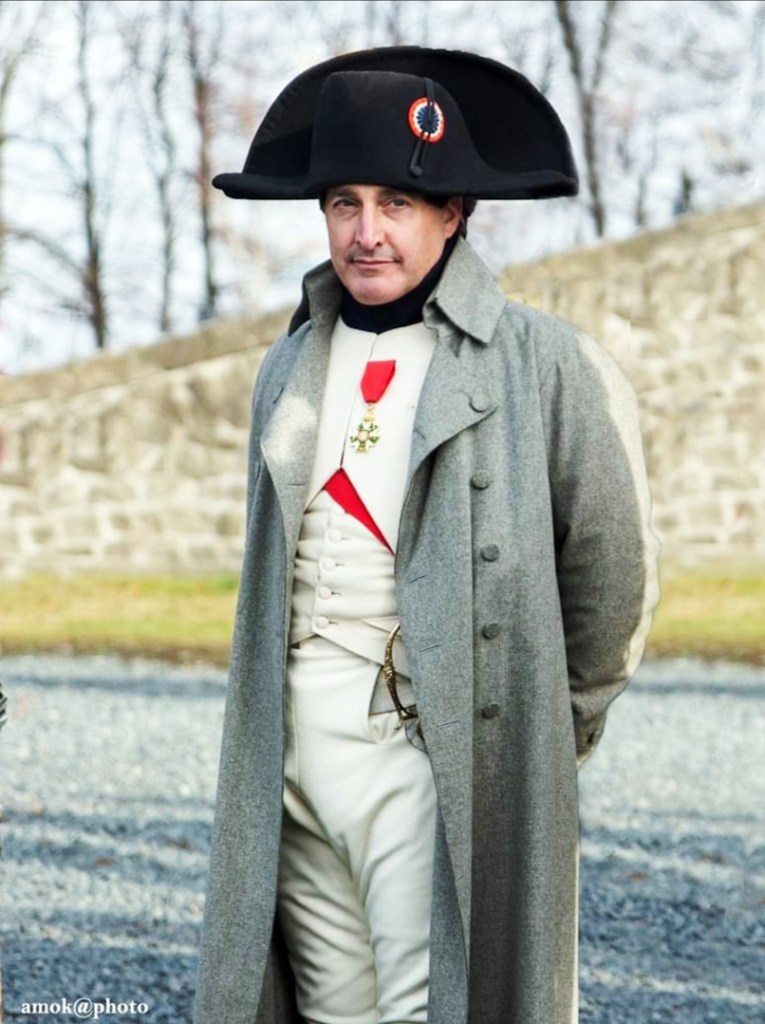
■ Uno de los aspectos más conocidos de Napoleón es su vestuario, el uniforme típico del coronel de Chasseurs à cheval de la Garde y su redingote gris. ¿Tu guardarropa ha evolucionado de alguna manera durante estos años? ¿Y qué grado de importancia le das en tu caracterización?
«Gran pregunta. Creo que los uniformes o disfraces, no nos gusta llamarlos disfraces, nos gusta llamarlos uniformes, son extremadamente importantes. Y la calidad de ellos utilizando los mismos materiales, teniendo el corte por un sastre adecuado para ajustarse al cuerpo como debe. Cuando sales al escenario o vas a una recreación o vas a una recreación a caballo, lo primero que el público y los recreadores van a ver eres a ti, tu disfraz y tu forma de comportarte. Así que eso ya va a decir mucho sobre quién eres. Entonces le doy mucho valor a los uniformes, al vestuario para la recreación. Y lleva tiempo. Se necesita dinero. Asume tu responsabilidad. Por ejemplo, si quiero seguir pareciendo el Napoleón de 1805 y no puedo hacerlo para siempre, pero ciertamente eso requiere que me mantenga en cierta forma en forma para lucir el papel de Napoleón, para retener esa energía. Tengo que practicar mi equitación casi todos los días. Entonces, cuando salgo al campo de batalla de recreación, miro en el lugar correcto como Napoleón a caballo. Entonces, si no tuviera un disfraz que se viera bien, se parecería más a un Carnaval que a un uniforme que usaría Napoleón. Entonces, mis uniformes, y tengo muchos de ellos, los que Napoleón habría tenido desde su uniforme de General de l’Armée de 1796 al 98 con el bordado dorado en el cuello y los puños hasta la transición al que estoy usando. ahora, el del Coronel de los Chasseurs à Cheval de la Garde Imperial, que en su sencillez de uniforme de coronel lo hacía destacar más que los mariscales del Imperio que lo rodeaban. Así es. Toda clase de bordados dorados y plumajes en sus sombreros. La simplicidad realmente lo hizo destacar. Así que sí, todo eso me parece muy, muy importante. Y trato de continuar no solo trabajando en los uniformes, sino también en mi físico, en los gestos, en la equitación, en el habla, en mis interacciones con los soldados. Todo eso es parte de la ecuación, en mi opinión, para lograr el éxito con la historia viva. Si sólo haces un aspecto, si tienes un uniforme perfecto, pero no sabes cómo comportarte con él, no va a funcionar. Si tienes un uniforme perfecto y te subes a un caballo y realmente no sabes montar, quedarás como un tonto. Si no sabes hablar en público o no recuerdas un discurso para dar a los soldados, no serás un Napoleón o un actor muy eficaz de ninguna manera.»
■ One of the best-known aspects of Napoleon is his wardrobe, the typical uniform of the colonel of Chasseurs à cheval de la Garde and his grey redingote. Has your wardrobe evolved in any way during these years? And what degree of importance do you give it in your characterization?
«Great question. I believe uniforms or costume, we don’t like to call them costumes, we like to call them uniforms are extremely important. And the quality of them using the same materials, having the cut by a proper tailor to fit the body the way it should. When you walk out on stage or walk out to a reenactment or ride out to a reenactment on your horse, the first thing the public and the reenactors are going to see are you and your costume and the way you carry yourself. So that is already going to speak volumes about who you are. So, I put high value in uniforms, in costumes for reenactment. And it takes time. It takes money. It takes your responsibility. For example, if I want to remain looking like the Napoleon of 1805 and I can’t do it forever, but certainly that requires me staying somewhat fit to look the part of Napoleon, to retain that energy. I have to practice my equitation just about every day. So, when I get out on the reenactment battlefield, that I look the proper place as Napoleon on horseback. So, if I didn’t have a costume that looked good, it would look more like Carnival than it would like a uniform that Napoleon would wear. So, my uniforms, and I have many of them, the ones that Napoleon would have had from his 1796 through 98 General de l’Armée uniform with the gold embroidery on the collar and the cuffs to the transition to the one I’m wearing now, that of the Colonel of the Chasseurs à Cheval de la Garde Imperial, which in its simplicity as a colonel’s uniform made him stand out more than the Marechaux de l’Empire that were surrounding him. That’s right. All sorts of gold embroidery and plumage in their hats. The simplicity really made him stand out. So yes, I find all of that very, very important. And I try to continue to not only work on the uniforms, but work on my physique, work on the mannerisms, work on the equitation, work on the speech, work on my interactions with the soldiers. All of that is part of the equation, in my opinion, to find success with living history. If you only do one aspect, if you have a perfect uniform, but you don’t know how to carry yourself in it, it’s not going to work. If you have a perfect uniform and you get on a horse and you don’t really know how to ride, you’re going to look foolish. If you don’t know how to speak in public or remember a speech to give to the soldiers, you’re not going to be a very effective Napoleon or actor in any way, shape or form.»
■Otro aspecto son los caballos de Napoleón. En cuanto a tus monturas, en general, ¿tienes tiempo para adaptarte a ellas o el calendario es tan apretado que no hay tiempo para muchas pruebas? ¿Y si has tenido algún tipo de problema por las circunstancias en algún momento de tu carrera con el caballo?
«Me encanta decir que hay una cita de un general francés llamado Nansouty. Era un comandante de caballería pesada y dijo: los caballos no tienen patriotismo, exigen su avena, lo que significa que no les importa que seas Napoleón en un momento dado de la recreación. Entonces ese es el desafío. Por eso trabajo tanto en equitación, porque cuando llego a estas recreaciones, tengo muy poco tiempo para acostumbrarme al caballo que me dan. Y hay que hacerlo lo mejor que puedas para que luzca lo mejor posible. Ciertamente, a los organizadores les gusta darme un caballo que haya hecho esto antes y tenga buen aspecto, porque saben que se van a tomar muchas fotografías y nadie quiere ver a Napoleón caerse de su caballo. Bueno, tal vez el enemigo lo haga. Pero, todos esos factores, todavía requieren que trabaje en mi equitación tan a menudo como sea posible.
Ahora tu pregunta, ¿alguna vez tuve malas experiencias? Sí, he tenido malas experiencias. Desafortunadamente, en uno de los eventos de Austerlitz, creo que pudo haber sido en 2016, yo estaba galopando con mi caballo y el suelo estaba muy resbaladizo y el caballo se resbaló debajo de mí y ambos caímos. Pero yo estaba bien, el caballo estaba bien y todo lo que podía hacer. Y había una multitud de más de 10.000 personas y se escuchó casi al unísono este suspiro cuando me caí del caballo. Pero todo lo que pude hacer fue asegurarme de que estaba bien, agarrar la crin del caballo, levantarme y seguir galopando y todos aplaudieron y estaban felices.
Pero ya sabes, Napoleón se cayó en muchas ocasiones. Y hay dos tipos de jinetes en el mundo, los que se han caído y los que caerán. Así que ahí está esa expresión. Es la naturaleza de los caballos. Pueden ser peligrosos, pero son parte de una recreación, así que acepto ese peligro».
■ Algunas personas dicen que, oh, Napoleón era un mal jinete, su estilo de montar. Pero creo que no mucha gente cabalga las horas, las semanas, los años, todos esos años sobre un caballo, ¿no?
«Sí, no, exactamente. Y lo he escuchado muchas veces antes. Dicen que Napoleón no era un buen jinete, pero tú lo acabas de decir. Cualquiera que vaya a pasar gran parte de su vida a caballo será un muy buen jinete en general. Lo que creo que decían es que tal vez no era un jinete de alta escuela, lo que los franceses llaman la Haute École, la alta escuela o un jinete de doma. Aunque sabemos que hacía que sus caballos hicieran trucos. Tenía más de 200 caballos diferentes. Algunos eran más adecuados para los desfiles, otros eran más adecuados para el campo de batalla y otros eran más adecuados para la caza.
Entonces, con todos estos caballos diferentes que monta todos los días, creo que Napoleón era un jinete bastante bueno. Y tal vez no al nivel de alguien como François de Robichon del siglo XVII, que escribió la “École de Caballerie”, pero aun así creo que era un muy buen jinete.»
■Another aspect are the horses of Napoleon. As for your mounts, in general, do you have time to adapt to them or is the schedule so tight that there is no time for many trials? And if you have had any kind of problem due to the circumstances at some point of your career with the horse?
«So, I love to say there’s a quote from a French general named Nansouty. He was a heavy cavalry commander and he said, horses have no patriotism, they demand their oats, meaning they don’t care that you’re Napoleon at a reenactment. So that is the challenge. That is why I work so much on equitation, because when I get to these reenactments, I have a very short amount of time to get used to the horse that is given to me. And you have to do your best to make him look as good as possible. Certainly, the organizers like to give me a horse that has done this before and looks good, because they know so many pictures are going to be taken and nobody wants to see Napoleon fall off his horse. Well, maybe the enemy does. But so, all of those factors, it still requires me to work on my horsemanship as often as possible. Now your question, did I ever have any bad experiences? Yes, I have had bad experiences. Unfortunately, at one of the Austerlitz events, I think it might have been 2016, I was galloping my horse and the ground was very slippery and the horse slipped out from under me and we both, we tumbled. But I was okay, the horse was okay and all I could do. And there was a crowd of over 10,000 people and you heard almost as one this sigh when I fell off the horse. But all I could do was make sure I was okay, grab the horse’s mane and pull myself up and continue to gallop along and they all clapped and were happy.
But you know, Napoleon came off on many occasions. And there’s two types of horsemen in the world, those that have fallen off and those that will. So there’s that expression. It’s the nature of horses. They can be dangerous, but they’re part of reenactment, so I accept that danger.»
■Some people say that, oh, Napoleon was a bad rider, his style of riding. But I think, but no more people ride the hours, the weeks, the years, those years over a horse, no?
«Yeah, no, exactly. And I’ve heard that many a time before. They say Napoleon was not a good horseman, but you just said it. Anyone who is going to spend much of their life on horseback is going to be a pretty good horseman overall. What I think they were saying is that he was not perhaps a high school, what the French call the Haute École, high school or dressage rider. Though we know he made his horses do tricks. He had over 200 different horses. Some were better suited for parades. Some were better suited for the battlefield. Some were better suited for hunting.
So, with all of these different horses that he’s riding each and every day, I think Napoleon was a pretty good horseman. And maybe not to the level that someone like François de Robichon of the 17th century who wrote the “École de Caballerie” was, but still, I think he was a very good horseman.»
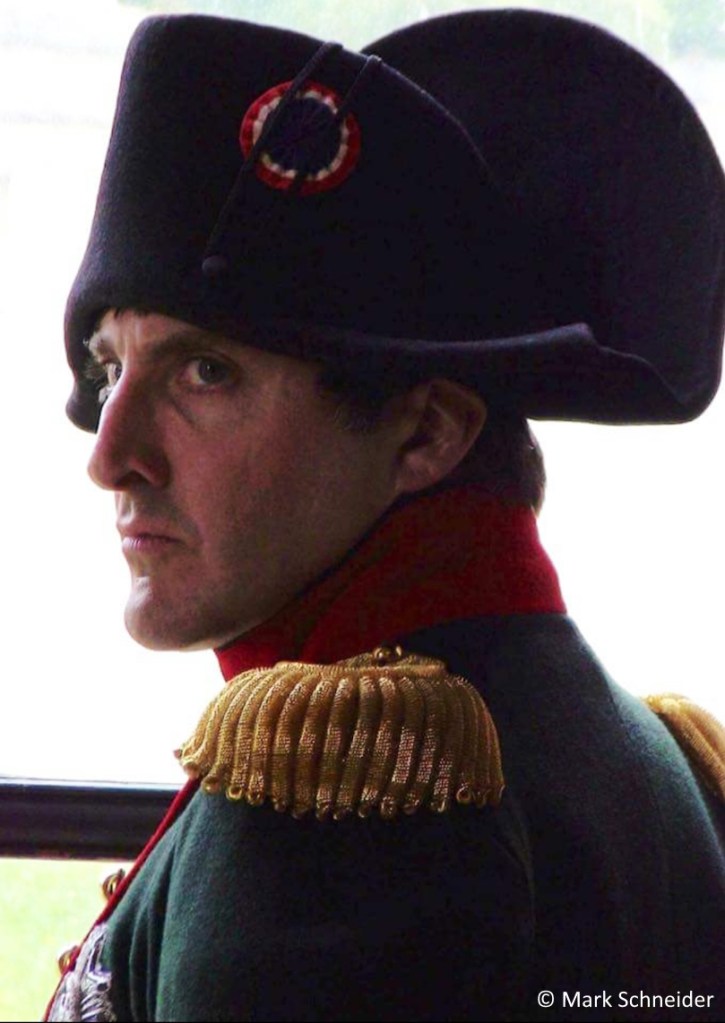
■ Mark Schneider, en uniforme de coronel de los Chasseurs à Cheval de la Garde, con una mirada penetrante, «la mirada de águila», que algunos de los contemporáneos del emperador también nos dejaron descrita.
■ Mark Schneider, in the uniform of a colonel of the Chasseurs à Cheval de la Garde, with a penetrating gaze, «the eagle gaze», which some of the emperor’s contemporaries also left us described.
■Nuestra última pregunta es para Napoleón, pero también es una pregunta para Mark Schneider. Después de un día con diversos eventos sociales, el más que probable baño de multitudes, cabalgar entre las tropas recreadas en el campo de batalla entre los vítores de los soldados, el ruido del combate, los cañones, las entrevistas, etc. Cuando se apagan las luces y vuelves al vestuario o a tu alojamiento para pasar el día, ¿normalmente revisas tu actuación y lo que pasó horas antes o simplemente quieres tener el momento para descansar?
«Siempre estoy revisando mi actuación. Siempre estoy tratando de mejorar. Siempre estoy tratando de hacerlo mejor. Vea en esa situación cómo podría haberlo hecho mejor o tal vez haber hecho algo diferente. Hay tiempo para descansar cuando llegue». De vuelta a casa. Desde el momento en que pongo un pie en el país en el que voy a participar, es ir, ir, ir y tratar de hacerlo lo mejor que pueda. Por eso es tan importante prepararse para un evento, hacer lo mejor que pueda. Lo mejor que puedes, obviamente, en el evento. Y luego, cuando el evento termina, revisas lo que pasó allí. Pero después de estos eventos, rara vez vuelvo a mi alojamiento, me acuesto y me voy a dormir. Siempre hay algo más que hacer. He hecho amigos maravillosos durante décadas haciendo esto. Y no siempre tenemos la oportunidad de vernos. Entonces, cuando tenga esta oportunidad, quiero estar cerca de ellos. Quiero caminar a través del vivaque. Quiero recorrer los campos. Quiero reunirme con estos soldados. Quiero cenar con estos soldados. Quiero hablar con ellos y tomarme fotos con ellos. Porque para ellos, así como ellos son mis soldados este fin de semana, yo soy su emperador este fin de semana. Entonces quiero devolver lo que me están dando. Entonces, si para mí es tan sencillo posar para cien o mil fotografías, está bien. Para eso estoy ahí. Y es un honor y un privilegio para mí hacerlo. Así que no hay tiempo para acostarme en mi cama. Y lo continuaré en el siguiente.»
■Después de tantos años con este personaje, ¿se llega a comprender el magnetismo que inspiraba Napoleón en el campo de batalla? Que conocemos por muchos recuerdos de quienes lo conocieron…
«Sabes, tengo mis redes sociales, ya sea mi Instagram, Napoleón en Estados Unidos, mi Facebook o incluso mi LinkedIn. Hay conexiones todos los días sobre Napoleón y su carisma. Y ciertamente, un tema del que realmente no hemos hablado es de la película de Ridley Scott y Joachin Phoenix. En lugar de eso, en retrospectiva, mucha gente ha estado comentando al respecto. Vienen directamente a mí contándome mis pensamientos y opiniones y esto y aquello. Y Entonces, no pasa un día, no pasa realmente una hora en la que no reciba algún tipo de mensaje relacionado con Napoleón. Entonces, Napoleón es realmente parte de mí. Es parte de mi vida. Y le doy la bienvenida. eso. Pero él siempre está presente conmigo».
■ Así que ese es el final de nuestra entrevista. Una vez más, gracias por compartir su tiempo y sus conocimientos con nosotros. Le deseamos éxito continuo en todos sus proyectos futuros.
■ Our last question is of Napoleon, but also a question for Mark Schneider. After a day with various social events, more than likely crowd bath, riding among the reenacted troops on the battlefield to the cheers of the soldiers, the noise of combat, the guns, interviews, etc. When the lights turn off and you go back to the dressing room of your accommodation for the day, do you normally review your performance and what happened hours before or just you want the moment to rest?
«I’m always reviewing my performance. I’m always trying to improve. I’m always trying to do better. See in that situation how I could have made it better or maybe done something different. There’s time to rest when I come back home. From the moment I set foot in the country that I’m going to participate in, it’s go, go, go and trying to do the best I can. That’s why it’s so important to prepare for an event, to do the best you can obviously at the event. And then when the event is over to review from what had happened there. But after these events, I rarely will go back to my accommodations and lay down and go to sleep. There’s always something else to do. I’ve made such wonderful friends over the decades of doing this. And we don’t always get a chance to see one another. So, when I get this opportunity, I want to be around them. I want to walk through the bivouac. I want to go through the camps. I want to meet with these soldiers. I want to have dinner with these soldiers. I want to talk with them and get pictures with them. Because for them, just as they are my soldiers for this weekend, I am their emperor for this weekend. So, I want to give back what they are giving to me. So, if it’s so simple for me to pose for a hundred or a thousand pictures, that’s okay. That’s what I’m there for. And it’s my honor and privilege to do that. So, there’s no time to lay down in my bed. And I’ll link it with the other one.»
■After so many years with this character, does one come to understand the magnetism that Napoleon inspired on the battlefield? Gathered but many memories of those who knew him…
«You know, I have, you know, my social media, whether it’s my Instagram, Napoleon in America, or my Facebook, or even my LinkedIn. There are connections every single day about Napoleon and the charisma. And certainly, in a subject we really have not talked about is the Ridley Scott, Joaquin Phoenix film. In lieu of that, in hindsight of that, so many people have been commenting about it. They come directly to me about my thoughts and opinions and this and that. And so, there’s not a day that goes by. There’s not really an hour that goes by where I’m not getting some sort of message that’s Napoleon related. So, Napoleon is really part of me. He’s part of my life. And I welcome that. But he is always ever present with me.»
■ So that’s the end of our interview. Once again, thank you for sharing your time and insights with us. We wish you continued success in all your future endeavors.»

■ Mark Schneider nació de padre estadounidense y madre francesa en Smithtown, Long Island, en 1969. Posee un título universitario por la Universidad Christopher Newport. Prestó servicio en el ejército de los Estados Unidos de 1993 a 1997, sirviendo en Bosnia-Herzegovina y Alemania. Trabaja habitualmente en el Colonial Williamsburg Living History Museum en Virginia (EE.UU), donde ha interpretado a Lafayette, Napoleón Bonaparte, Banastre Tarleton y otros personajes de la historia de Estados Unidos. Desde 2005 ha participado en casi 100 eventos como Napoleón Bonaparte, en numerosos países como Austria, Bélgica, República Checa, Francia, Alemania, Italia, Rusia, España y Estados Unidos.
■ Mark Schneider was born to an American father and a French mother in Smithtown, Long Island, in 1969. He has a bachelor’s degree from Christopher Newport University. He served in the United States Army from 1993 to 1997, serving in Bosnia-Herzegovina and Germany. He regularly works at the Colonial Williamsburg Living History Museum in Virginia (USA), where he has portrayed Lafayette, Napoleon Bonaparte, Banastre Tarleton and other characters in American history. Since 2005 he has participated in almost 100 events as Napoleon Bonaparte, in numerous countries such as Austria, Belgium, Czech Republic, France, Germany, Italy, Russia, Spain and the United States.
Fuentes:
1 – https://www.austerlitz.org/en/210th-anniversary-of-the-battle-of-znaim-mark-schneider-aka-napoleon/
3 – https://web.archive.org/web/20090107031059/http://www.chevaux-de-napoleon.net/p7.html
Imágenes:
a – Portada: Original DE ROCKER / Alamy Foto, alterada con filtros Adobe Photoshop.
b – Fotos facilitadas por Mark Schneider y de su página Instagram: https://www.instagram.com/napoleon_in_america/?hl=en.
 elrincondebyron.com