


Tiempo de lectura: 15 minutos
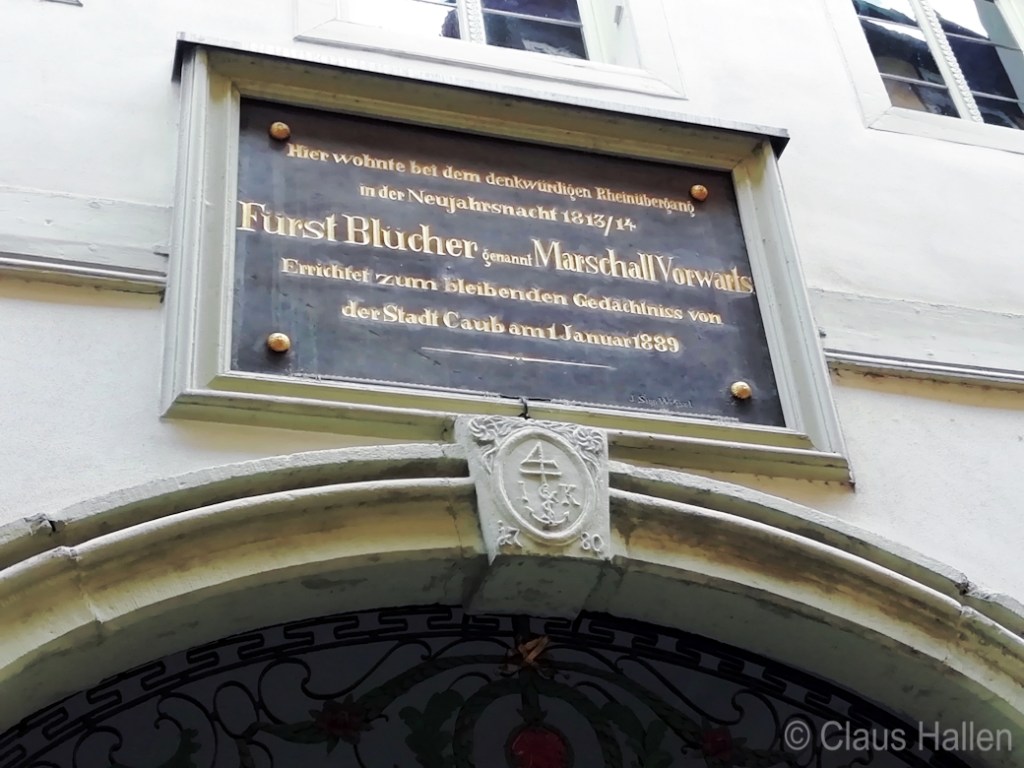
El Museo Blücher en la ciudad alemana de Kaub, es un lugar lleno de historia y emoción, que transporta a sus visitantes a una época crucial en Europa: el declive del imperio napoleónico y el enfrentamiento de las potencias aliadas para derrotar a Napoleón Bonaparte. Kaub, situada a orillas del río Rin, fue testigo de un evento trascendental durante esta etapa de la historia europea, y el museo rinde homenaje a ese momento crucial. Las vitrinas exhiben una amplia gama de armas de la época, desde espadas y sables hasta pistolas y mosquetes. Los uniformes de los países involucrados están meticulosamente reproducidos permitiendo a los visitantes imaginar cómo se veían los soldados de la época. Sin duda, este museo es un destino obligado para los entusiastas de la historia y los amantes de la era napoleónica en el que cual, las fotografías de Claus Hallen y Karl-Heinz Kieckers y los textos de este último nos introducen a continuación.
The Blücher Museum in the German city of Kaub is a place full of history and emotion, which transports its visitors to a crucial time in Europe: the decline of the Napoleonic empire and the confrontation of the Allied powers to defeat Napoleon Bonaparte. Located on the banks of the Rhine River, Kaub witnessed a momentous event during this period in European history, and the museum pays tribute to that pivotal moment. The display cases display a wide range of weapons of the period, from swords and sabers to pistols and muskets. The uniforms of the countries involved are meticulously reproduced allowing visitors to imagine what the soldiers of the time looked like. Without a doubt, this museum is a must-see destination for history enthusiasts and lovers of the Napoleonic era, which the photographs of Claus Hallen and Karl-Heinz Kieckers and the texts of the latter introduce us to below.
KAUB. SUS ALREDEDORES, HISTORIA Y MUSEO. KAUB. ITS SURROUNDINGS, HISTORY AND MUSEUM.
El paisaje
Estamos en el valle superior del Rin Medio. Aquí, entre las ciudades de Bingen1 y Coblenza, el Rin atraviesa las montañas renanas de pizarra y forma parte de la cadena montañosa baja alemana. El estrecho valle con pendientes pronunciadas y afloramientos rocosos sobresalientes, llamado «Leien»2, es Patrimonio de la Humanidad por la UNESCO. La corriente, por lo demás bastante tranquila, fluye a gran velocidad en numerosos meandros. Los bajíos y acantilados ponen en peligro aún más la navegación. Un gran número de castillos en lo alto de las colinas sirvieron en el pasado no sólo como residencias de caballeros, sino también como estaciones de aduanas para el tráfico comercial a lo largo del río. Sin embargo, algunos de los castillos que han sobrevivido hasta nuestros días no fueron construidos hasta el siglo XIX por ricos industriales. El paisaje sigue dominado por los viñedos, algunos de los cuales parecen estar pegados a las escarpadas rocas. Todo esto consolidó la imagen del «Rheinromantik» transfigurada por escritores como Goethe, Byron y Shelley, así como por pintores como Turner. A esta parte del río se puede llegar en coche, en tren o mediante un servicio regular de barco. Este último ofrece Kaub como deseada parada. El viaje en barco es muy relajante y ofrece muchas vistas de viñedos, castillos y ciudades históricas. El viaje se inicia en Maguncia3, río arriba, o en Coblenza, río abajo.
The landscape
We are in the Upper Middle Rhine Valley. Here, between the cities of Bingen1 and Koblenz, the Rhine cuts through the Rhenish Slate Mountains being part of the German low mountain range. The narrow valley with steep slopes and protruding rocky outcrops, called “Leien”2, is an UNESCO World Heritage Site. The otherwise rather sedate stream flows in numerous meanders at high speed. Shoals and cliffs further endanger navigation. A large number of hilltop castles once served not only as knights’ residences, but also as customs stations for trade traffic on and along the river. However, some of the castles that have survived to this day were only built in the 19th century by wealthy industrialists. The landscape is still dominated by vineyards, some of which seem to be glued to the rugged rocks. All this consolidated the image of the «Rheinromantik» transfigured by writers such as Goethe, Byron and Shelley, as well as by painters for example Turner. This part of the river can be reached by car, by train or by a scheduled boat service. The latter offers Kaub as a desired stop. The boat trip is very relaxing and offers many views of vineyards, castles and historic towns. One starts the journey either upstream in Mainz3 or downstream in Koblenz.

Contexto histórico
La topografía proporciona el contexto histórico de la época napoleónica y, en particular, del cruce del Rin por parte del 1er ejército de Silesia compuesto por prusianos y rusos el día de Año Nuevo de 1814. Todas las zonas de la margen izquierda del Rin, desde Basilea hasta la frontera de los Países Bajos todavía estaban ocupadas por los franceses. Esto incluía la fortaleza de Maguncia y las ciudades fortificadas de Koblenz y Colonia. No había puentes de piedra ni de madera. Como cruces servían puentes de pontones permanentes (p. ej., cerca de Colonia) o puentes voladores4 (Koblenz, St. Goar, Düsseldorf). Todas estas construcciones podían ser fácilmente desmanteladas o destruidas, como hicieron los franceses en su retirada tras la derrota de Leipzig. Aunque el Rin se helaba en inviernos duros, las zonas finas y las capas de hielo que se disolvían repentinamente representaban un gran peligro para la vida al cruzarlo a pie, a caballo, en carro o en carruaje.
Kaub, en la margen derecha del Rin, pertenecía al ducado de Nassau, antiguo miembro de la Confederación del Rin, luego «liberado» por los aliados. La pequeña ciudad constituía un punto de partida adecuado para un puente de pontones, ya que la antigua fortaleza aduanera Pfalzgrafenstein, ubicada en el centro del Rin, podría servir como punto fijo adicional. Atacar la fortaleza de Maguncia directamente al otro lado del Rin era imposible, ya que los baluartes de la fortaleza en la orilla derecha del Rin todavía estaban bien defendidos por los franceses. Así, el cruce de Kaub tenía como objetivo permitir un cerco completo de la fortaleza de Maguncia.
Historical Context
The topography provides the historical context for the Napoleonic era and especially for the crossing of the Rhine by the 1st Silesian Army consisting of Prussians and Russians on New Year’s Day 1814. All areas on the left bank of the Rhine from Basel to the border of the Netherlands were still occupied by the French. This included the fortress of Mainz and the fortified cities of Koblenz and Cologne. There were no stone or wooden bridges. Permanent pontoon bridges (e.g. near Cologne) or flying-bridges4 (Koblenz, St. Goar, Duesseldorf) served as crossings. All these constructions could be easily dismantled or destroyed, which the French did on their retreat after the defeat at Leipzig. Although the Rhine froze over in hard winters, thin spots and suddenly dissolving ice jam posed a great danger to life when crossing on foot, by horse, cart or coach.
Kaub on the right bank of the Rhine belonged to the Duchy of Nassau, a former member of the Confederation of the Rhine, then «liberated» by the Allies. The small town formed a suitable starting point for a pontoon bridge, since the former customs fortress Pfalzgrafenstein, located in the middle of the Rhine, could serve as an additional fixed point. To attack the fortress of Mainz directly across the Rhine was impossible, since the fortresses bulwarks on the right bank of the Rhine were still well defended by the French. Thus, the crossing at Kaub was intended to enable a complete encirclement of the Mainz fortress.

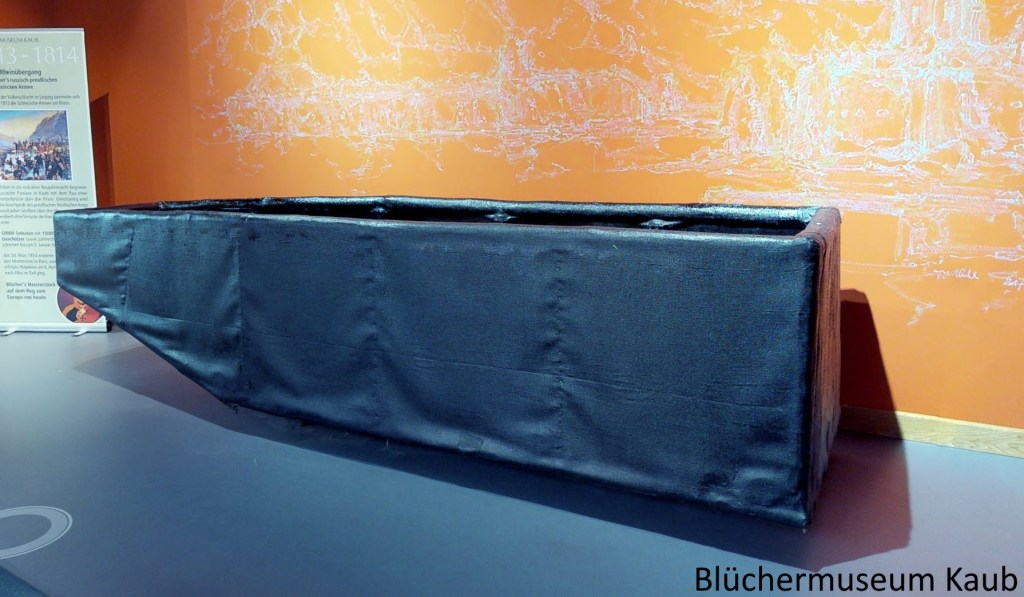
Ya en época navideña se iniciaron intensos trabajos preparatorios. Se reunieron todas las barcazas disponibles en los alrededores y los zapadores rusos construyeron pontones con lonas alquitranadas estiradas sobre una estructura de madera. Los preparativos ciertamente no pasaron desapercibidos, pero los franceses continuaron concentrándose en la defensa directa de la fortaleza de Maguncia. Pronto también el comandante en jefe del ejército de Silesia, el general Blücher, se instaló en la posada «Zur Stadt Mannheim» en Kaub. Esta casa se convirtió en un monumento conmemorativo y hoy alberga el Museo Blücher.
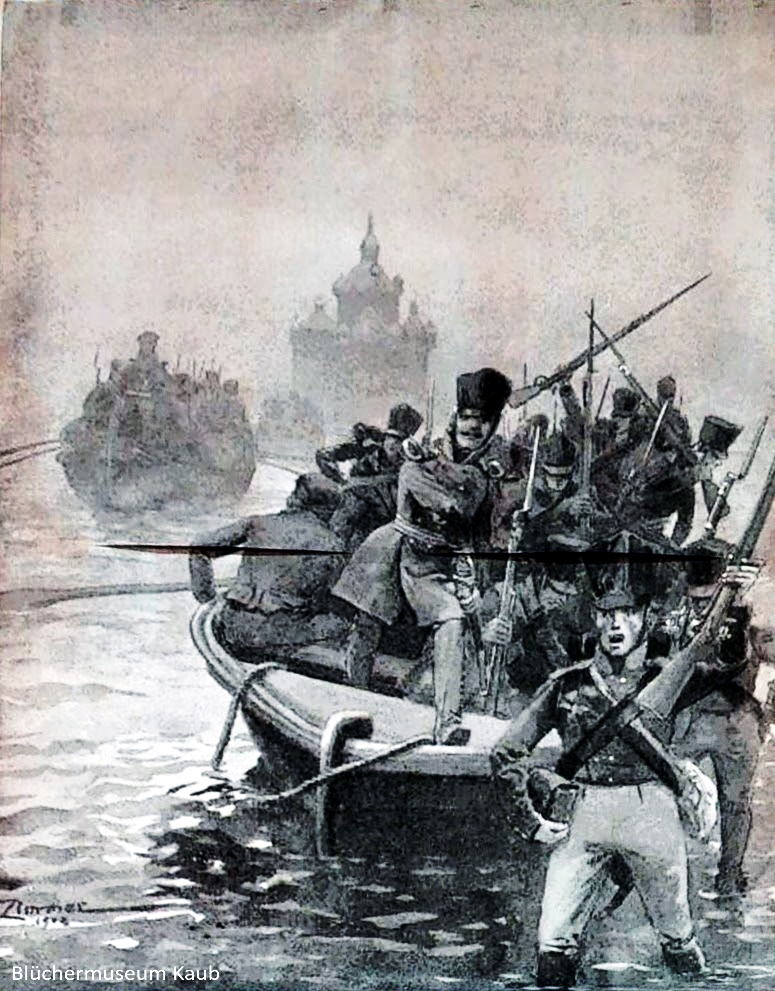
Supongo que el curso posterior de la historia es conocido. Ya en el año viejo (1813) se terminó el puente de pontones y las formaciones prusiano-rusas pudieron cruzar el Rin en la noche de Año Nuevo sin mucha resistencia en pocos días. No obstante, la guarnición francesa de Maguncia resistió durante bastante tiempo. Sin embargo, la fortaleza tuvo que ser abandonada tras el estallido de una epidemia de tifus. Esto despejó el camino para que los aliados invadieran Francia.
Extensive preparatory work began as early as around Christmas time. All available barges were gathered together from the surrounding area and Russian sappers constructed pontoons from tarred canvas stretched over a wooden framework. The preparations certainly did not go unobserved, but the French continued to concentrate on the direct defence of the Mainz fortress. Soon the commander-in-chief of the Silesian Army, General Blücher also took up quarters in the inn «Zur Stadt Mannheim» in Kaub. This house became a memorial and today it houses the Blücher Museum.
The further course of history I presume as known. Still in the old year (1813) the pontoon bridge was finished and the Prussian-Russian formations could cross the Rhine in the New Year’s night without considerable resistance within a few days. The French garrison of Mainz nevertheless held out for quite a while. However, the fortress had to be abandoned after the outbreak of a typhus epidemic. This cleared the way for the Allies to invade France.
El Museo
Desde la última vez que visité este museo en 2015, han ocurrido muchas cosas. El museo, dirigido por las autoridades de la ciudad y un grupo muy activo de amigos, se ha ampliado considerablemente y la exposición es ahora muy moderna y didáctica. Esto fue posible gracias a muchos patrocinadores privados y a una subvención de los fondos del Patrimonio Mundial de la UNESCO. Las salas originales del museo muestran el cuartel general de Blücher en parte todavía en su estado original, complementado con retratos y objetos expuestos individuales en el original, como el cofre de guerra de hierro. Las salas recién añadidas tratan diferentes temas. Comienza con una presentación histórica general. A esto le siguen breves retratos de las personalidades más importantes, una colección de figuras con los distintos uniformes de los ejércitos implicados, un recorrido por las líneas imperiales de telégrafo óptico de Metz a Maguncia (muy interesante) y una reconstrucción de un pontón ruso.
The museum
Since I last visited this in 2015, a lot has happened there. The museum, which is run by the city authorities and a very active group of friends, has been significantly expanded and the exhibition is now very modern and didactic. This was made possible by many private supporters and a grant from UNESCO World Heritage funds.
The original rooms of the museum show Blücher’s headquarters partly still in its original state, supplemented by portraits and individual exhibits in the original, such as the iron-armed war chest. The newly added rooms deal with different topics. It begins with an overall historical presentation. This is followed by short portraits of the most important personalities, a collection of figures in the various uniforms of the armies involved, an excursus on the imperial optical telegraph lines from Metz to Mainz (very interesting) and a reconstruction of a Russian pontoon.


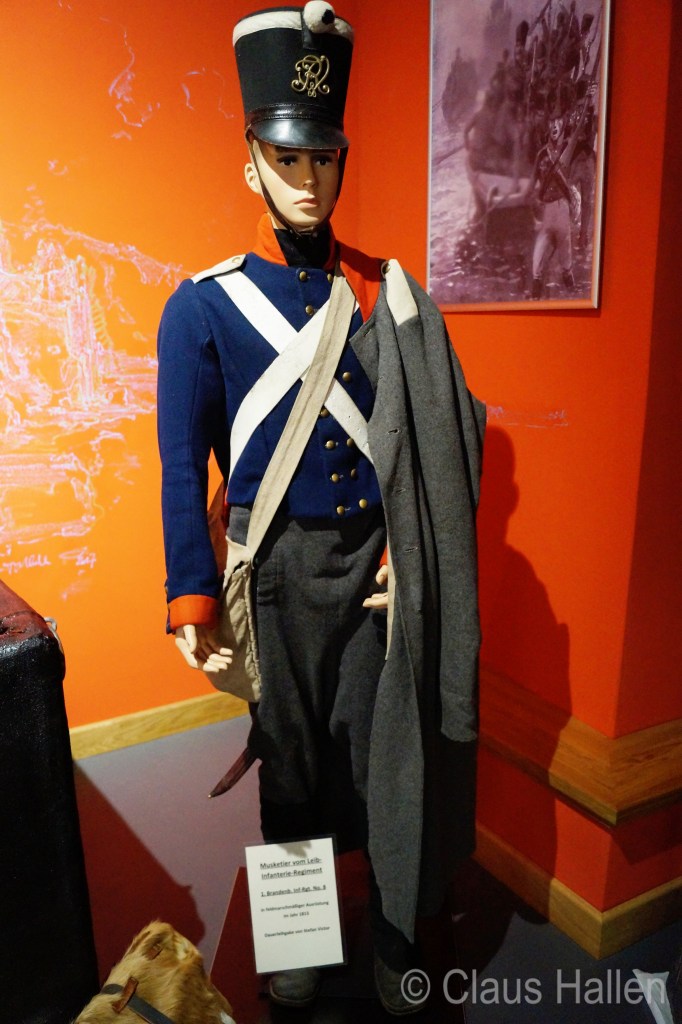


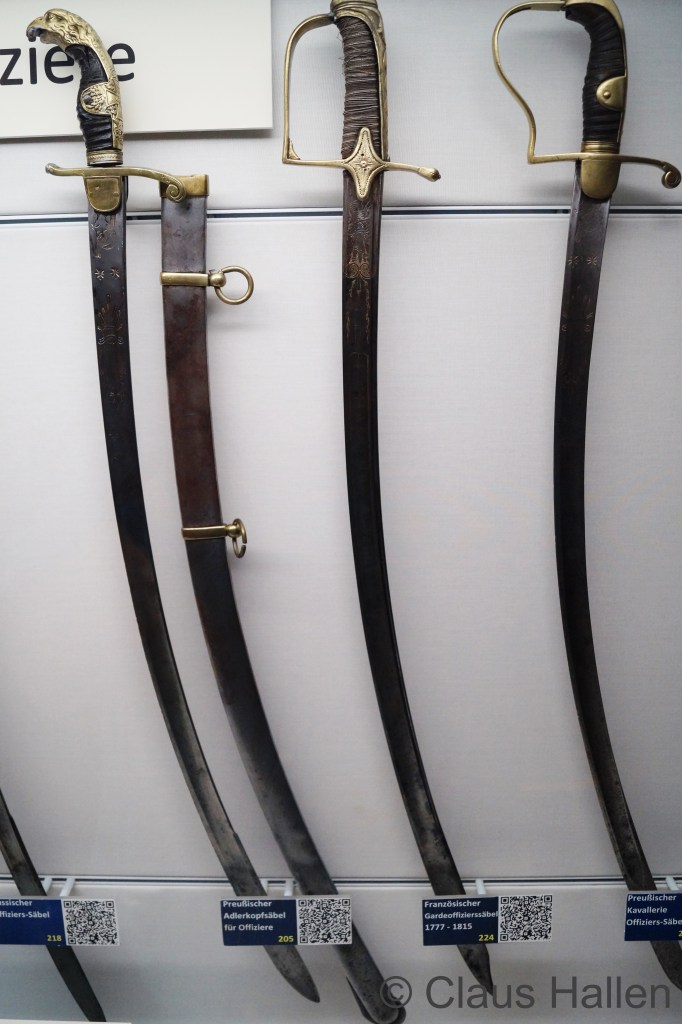
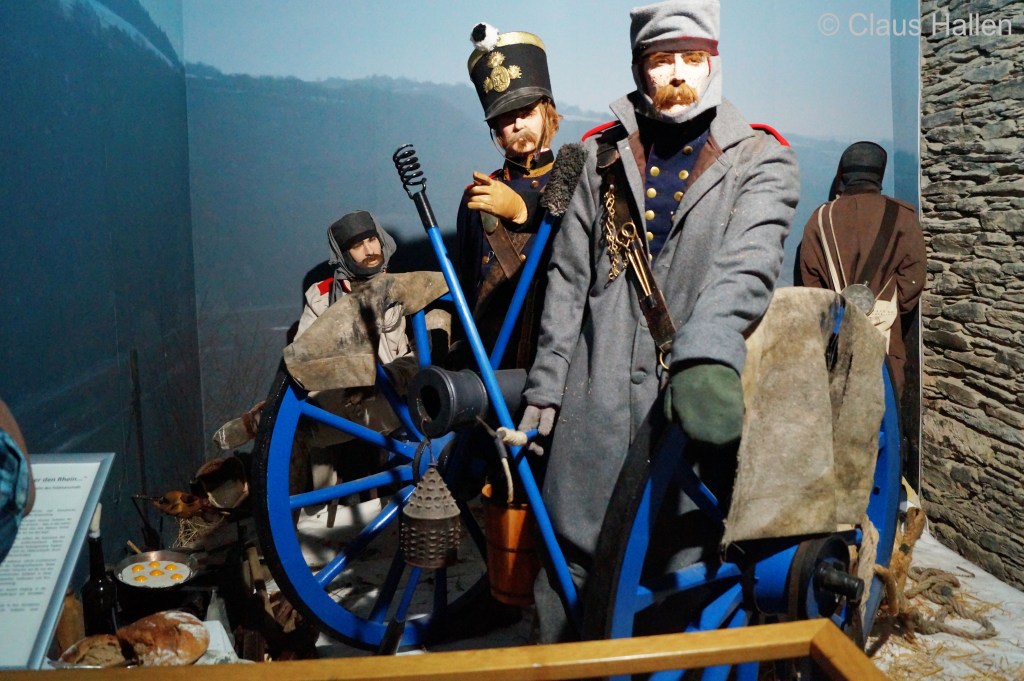
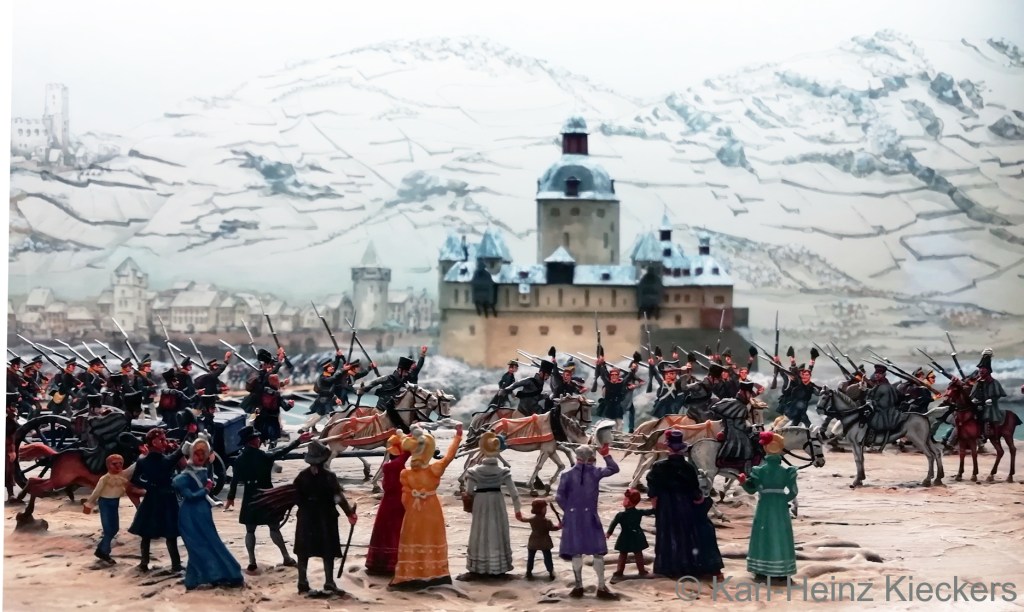
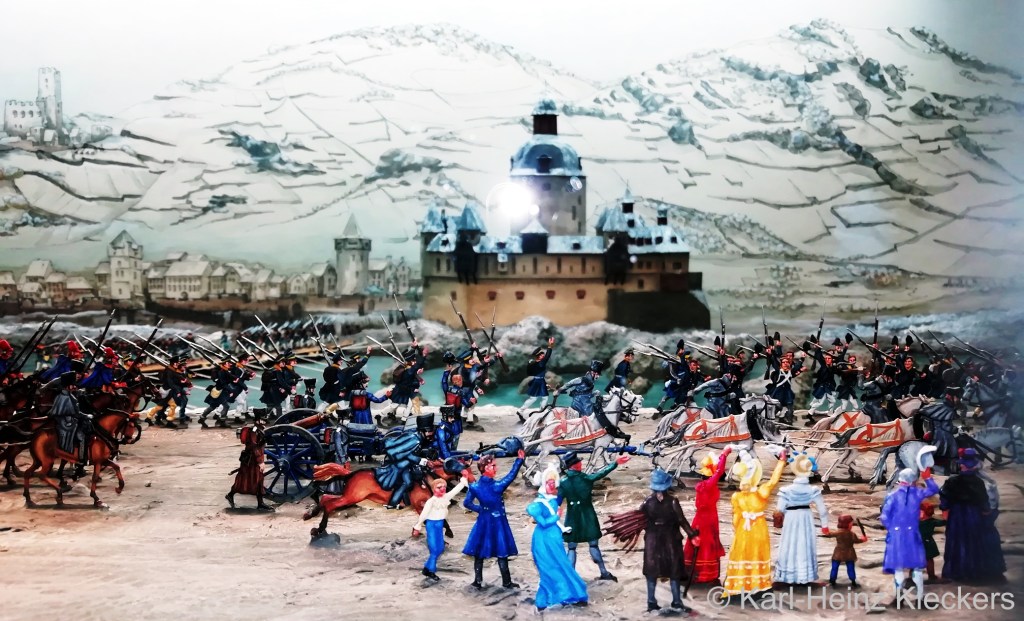
Una y otra vez aparecen representaciones a tamaño natural de los soldados, tanto aliados como franceses. Varias vitrinas contienen un número considerable de armas y equipos, que también permiten comparaciones directas. El cruce se visualiza mediante un gran diorama con figuras planas pintadas y una viñeta del tamaño de una pared de la vida en el campamento con figuras de tamaño natural. El diorama, por cierto, tiene la misma perspectiva que la pintura circular del cruce del Rin creada en 1902, de la que hablaré más adelante. La viñeta es expresiva. En el borde mismo se encuentra incluso un soldado con el antiguo uniforme del Gran Ducado de Berg. Sin embargo, cabe señalar que esta fuerza se desplegó principalmente frente a los bastiones en la margen derecha del Rin, cerca de Maguncia, por lo que probablemente no participó en el cruce de Kaub.
Again and again, there are life-size representations of the soldiers, both Allies and French. Several display cases contain a considerable number of weapons and equipment, which also allow direct comparisons. The crossing is visualized by a large diorama with painted flat figures and a wall-sized vignette of camp life with life-size figures. The diorama, by the way, has the same perspective as the circular painting of the Rhine crossing created in 1902, which I will discuss later. The vignette is expressive. At the very edge, there is even a soldier in the old uniform of the Grand Duchy of Berg. It should be noted however, that this force was mainly deployed in front of the bastions on the right bank of the Rhine near Mainz, and thus was probably not involved in the crossing at Kaub.

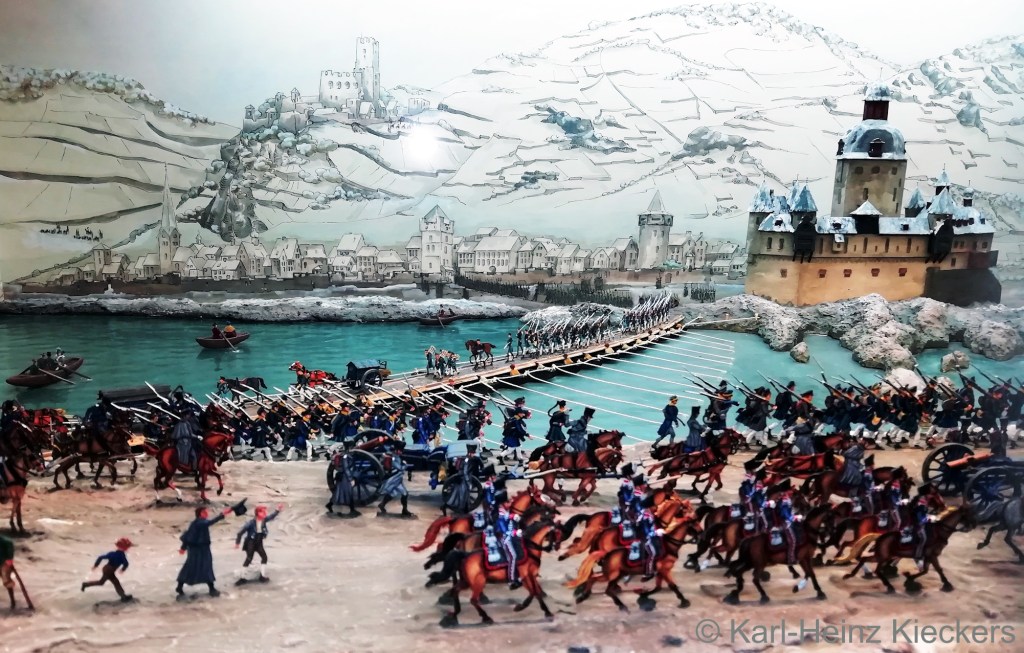
El diorama del paso del rio Kaub, con las típicas figuras planas de peltre. / Diorama of the Kaub River crossing, with the typical flat pewter figures.
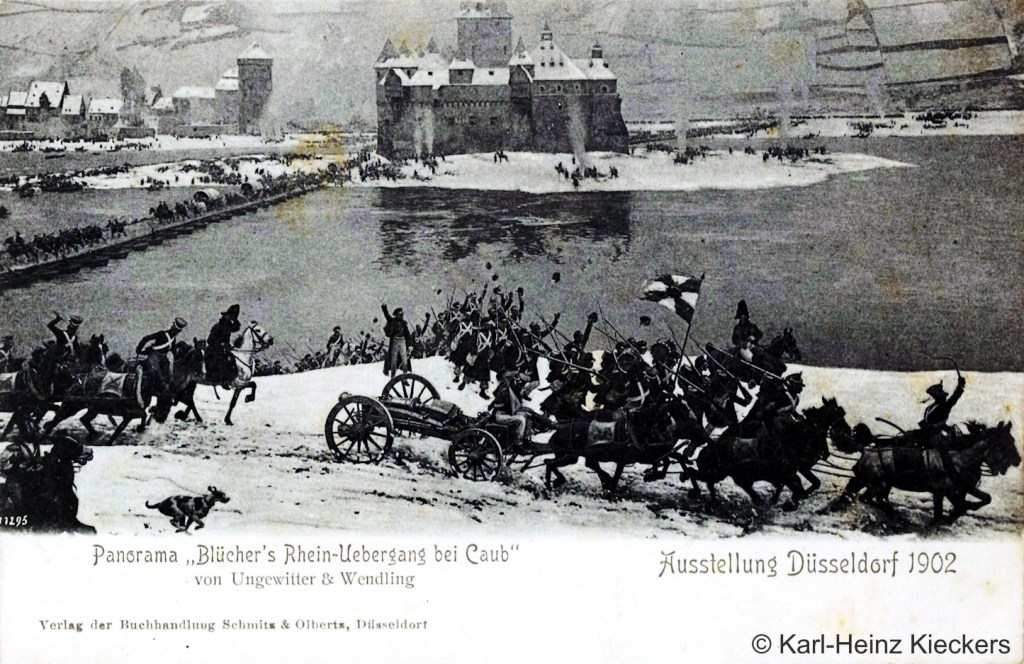
El recorrido continúa con una sala donde se proyecta una película sobre los hechos. Escenas de recreación animan la película y hacen referencia al espectáculo anual5 que se desarrolla en el lugar. Por último, una pared entera muestra todos los monumentos de Blücher repartidos por toda Europa. La variedad es asombrosa. Enfrente se encuentra la representación y la historia del panorama, una pintura circular de 1902 que representa el cruce del Rin, creada con motivo de la exposición industrial y comercial de Düsseldorf. Posteriormente se mostró en Berlín. Sin embargo, fue destruido durante la Segunda Guerra Mundial, lamentablemente sin que se documentara previamente en detalle. Aquí, sin embargo, la pintura circular experimenta una tardía apreciación.
Por cierto, el personal es muy amable y servicial. Una pequeña tienda ofrece una pequeña selección de literatura.
The tour continues with a room where a film about the events is shown. Reenactment scenes enliven the film and refer to the annual spectacle5 that takes place on site. Finally, an entire wall displays all Blücher monuments scattered throughout Europe. The variety is astonishing. Opposite we find the depiction and history of the panorama, a circular painting from 1902 depicting the crossing of the Rhine, which was created on the occasion of the industrial and trade exhibition in Düsseldorf. Later it was shown in Berlin. However, it was destroyed during the 2nd World War, unfortunately without being documented in detail beforehand. Here, however, the circular painting experiences a late appreciation.
By the way, the staff is very friendly and helpful. A little shop offers a small selection of literature.

Alrededores del museo
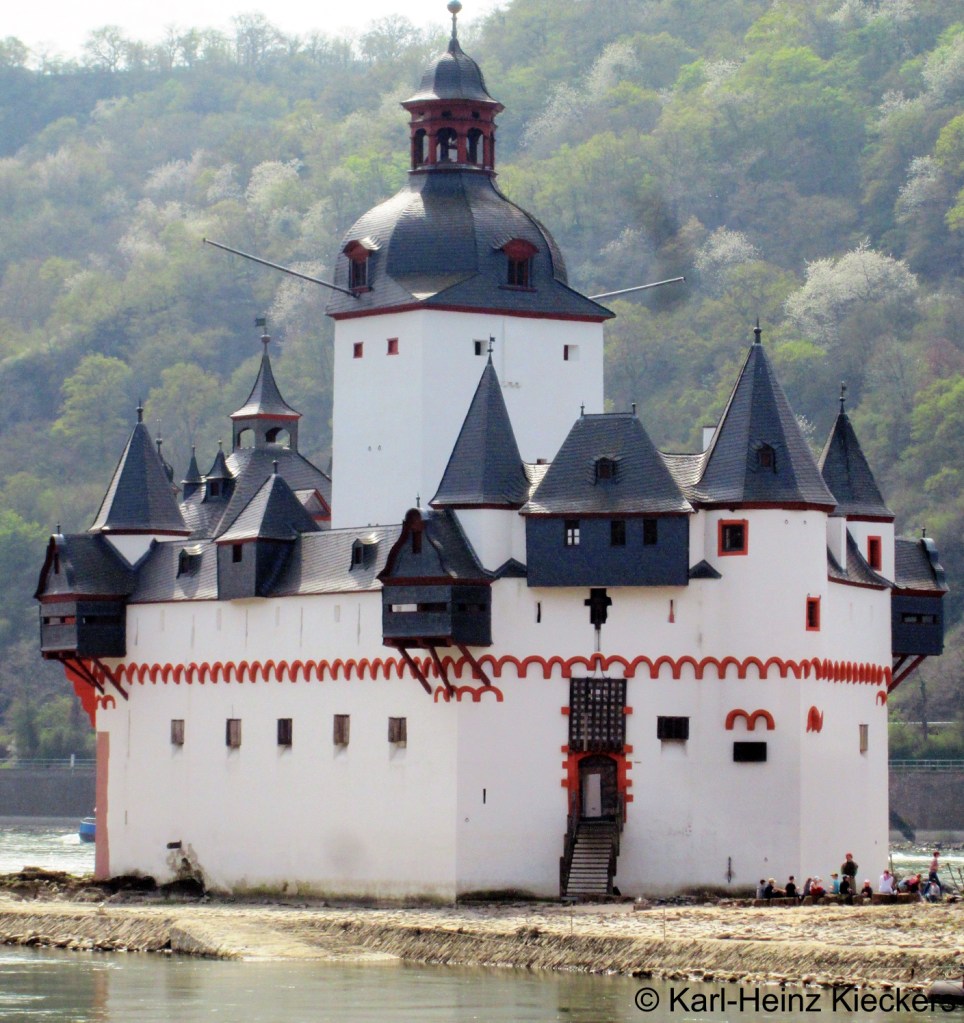
Después de una visita al museo, el monumento a Blücher no está muy lejos. Está claramente situado a orillas del Rin y se puede llegar a él a través de un paso subterráneo para peatones en la línea ferroviaria. Desde allí la vista se dirige hacia el oeste, pasando por la aduana de Pfalzgrafenstein, hacia la orilla occidental, siguiendo el antiguo trazado del puente de pontones. Elevándose abruptamente por encima de la orilla derecha y, por tanto, por encima de Kaub se encuentra el castillo de Gutenfells, hoy convertido en hotel. De camino al castillo podrá disfrutar de todo el panorama y ver el Pfalzgrafenstein con forma de barco. A este último se puede llegar en un pequeño ferry para hacer turismo. La fortaleza es estructuralmente interesante y alberga un hermoso interior. Sin embargo, no contiene ninguna referencia al cruce del Rin por parte de Blücher. En la plaza del pueblo de Kaub también se encuentra un monumento a la guerra franco-prusiana de 1870/71, flanqueado por dos cañones de aquella época.
Surroundings of the museum
After a visit to the Museum, the Blücher monument is not far away. It is unmistakably located on the banks of the Rhine and can be reached through a pedestrian underpass of the railway-line. From there, the view goes west, past the Pfalzgrafenstein customs fortress to the west bank, following the former course of the ponton-bridge. Rising steeply above the right bank and thus above Kaub is Gutenfells Castle, today a hotel. On the way to the castle, you can enjoy the whole panorama and view the ship-shaped Pfalzgrafenstein. The latter can be reached by a small ferry boat for sightseeing. The fortress is structurally interesting and houses some handsome interior. However, it does not contain any references to Blücher’s crossing of the Rhine. On the village square of Kaub there is also a memorial to the Franco-Prussian War of 1870/71 flanked by two cannons from that time.

Alrededores de Kaub
Si bien es mejor evitar los puntos turísticos como Rüdesheim y Bacharach, también se pueden hacer excursiones a Coblenza, a la fortaleza prusiana de Ehrenbreitstein6, a Marksburg y su castillo-museo cerca de Braubach, al monumento de Niederwald cerca de Assmannshausen , pero sobre todo a Maguncia con sus numerosos restos de la época romana, el «Landemuseum«, la ciudadela con museo y el singular «Museum für Antike Schiffahrt” valen la pena.
Surroundings of Kaub
While it is better to avoid the tourist hotspots such as Rüdesheim and Bacharach, further trips to Koblenz to the Prussian fortress Ehrenbreitstein6, to the Marksburg and its castle museum near Braubach, to the Niederwald monument near Assmannshausen, but above all to Mainz with its numerous remains of the Roman era, the “Landemuseum”, the citadel including museum and the unique “Museum für Antike Schiffahrt” are worthwhile.
Conclusión
Merece la pena visitar el Museo Blücher y todo el valle del Alto Medio Rin. Sin embargo, a pesar de todo el entusiasmo, lamento decir que las ciudades más pequeñas en particular han sufrido mucho debido a la pandemia de Corona. Además, hoy en día muchos turistas aprovechan los paquetes de cruceros de los grandes hoteles y ni siquiera visitan las ciudades pequeñas. Muchas tiendas, hoteles y restaurantes tuvieron que cerrar por estos motivos. Por eso, algunos lugares dejan una impresión desoladora. Lamentablemente, Kaub es uno de ellos. Me da tristeza porque lo recuerdo de tiempos mejores.
Karl-Heinz Kieckers 10/2023
Conclusion
The Blücher Museum and the entire Upper Middle Rhine Valley are worth a visit. However, despite all the enthusiasm, I am sorry to say that the smaller towns in particular have suffered greatly as a result of the Corona pandemic. In addition, many tourists nowadays use the package deals on the large hotel cruising boots and don’t even get to see the small towns anymore. Many stores, hotels and restaurants had to close for these reasons. Thus, some places leave a desolate impression. Kaub is unfortunately one of them. It makes me sad because I remember it from better times.
Karl-Heinz Kieckers 10/2023
– – – o – – –
1Cerca de Maguncia
2Leien singular Lei/Ley: el afloramiento rocoso de Lorelei se hizo famoso gracias a un poema de Heinrich Heine y Erpeler Ley en relación con la batalla por el puente de Remagen en 1945.
3Eso significa en el Sur.
4Ferry de cuerda, una plataforma flotante conectada a la orilla por una cuerda y puesta en movimiento por la corriente.
5En mayo o junio
6Construido entre los años 1817 y 1828.
– – – o – – –
1Near Mainz
2Leien singular Lei/Ley – the Lorelei rocky outcrop became famous through a poem by Heinrich Heine and the Erpeler Ley in connection with the battle for the bridge of Remagen in 1945
3That means in the South
4Rope ferry, a floating platform connected to the shore by a rope and set in motion by the current.
5In May or June
6Built between the years 1817 and 1828
Fuentes:
1 – Manuscrito «The Bluecher Museum near Kaub and the Upper Middle Rhine Valley» – Karl-Heinz Kieckers, Octubre 2023
2 – «New Year 1813/1814: Across the Rhine with Bluecher at Kaub» – Bruno Dreier, Kaub, 1996
Imágenes:
a – Imágenes por gentileza de Claus Hallen.
b – Imágenes por gentileza de Karl-Heinz Kieckers.
c – By Wilhelm Camphausen – Self-photographed im Mittelrhein-Museum Koblenz, Public Domain, https://commons.wikimedia.org/w/index.php?curid=32123276
d – Visita virtual web Blüchermuseum Kaub
e – Fotografías del autor.
 elrincondebyron.com
Menudo museo. Genial.
Me gustaMe gusta
Si te ha gustado la entrada, ya ha cumplido su cometido. La web del Blüchermuseum también tenía una visita virtual, donde podías ver casi todo el interior del museo.
Me gustaMe gusta